
Choosing a Compression Moulding Press: Tonnage, Platen Size, Daylight and More

A compression moulding press is a hydraulic (or sometimes mechanical or servo) press that closes a heated mould on a charge of material and holds pressure while the part cures. Choosing one means matching five things to your parts and moulds: tonnage (clamping force), platen size, daylight and stroke, closing speed control, and ejection and heating provisions. Get these right and moulds run smoothly; get them wrong and even a perfect mould will make flash, short fills or warped parts.
At Prime Tools we design every mould around the customer’s press, and every mould is tried on a press before dispatch. This guide explains what to check. We deliberately do not give a one-size tonnage formula: every moulder and material supplier uses different pressure factors, safety margins and standards, so the final figure should come from your material datasheet and your toolmaker’s DFM review.
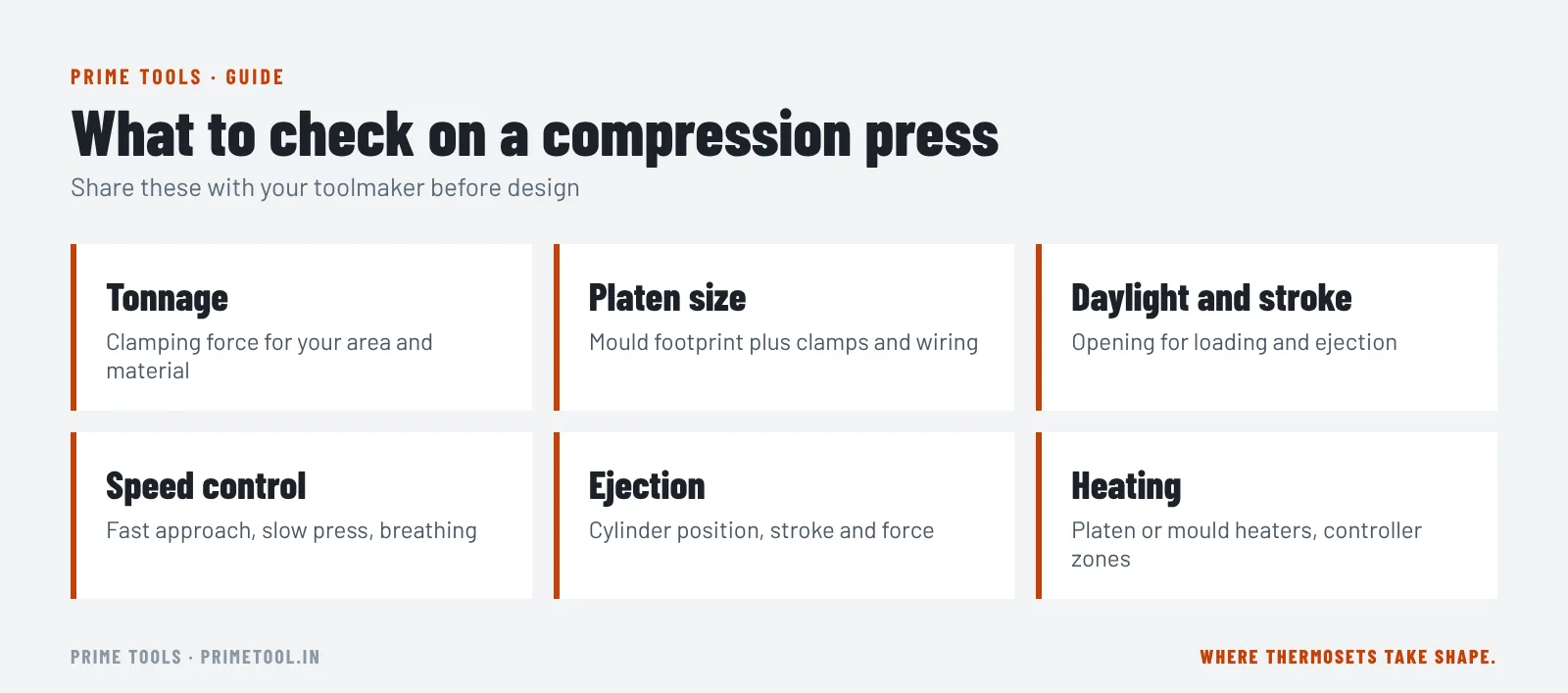
1. Tonnage (clamping force)
Tonnage is the maximum force the press can apply. It must be enough to make the material flow, fill the cavity and stay closed against the moulding pressure without the mould opening and flashing.
What drives the tonnage you need:
- Projected area of the part (and the shear edge) seen from the press direction. Bigger area needs more force.
- Material and grade: SMC, DMC, phenolic and melamine need different moulding pressures; each supplier gives a recommended range.
- Part depth and flow length: deep parts and long flow paths need more pressure.
- Your standards and margin: most moulders add a margin so the press is not run at its limit.
This is why we did not build a tonnage calculator for our downloads page: the right number is specific to your material and your company’s standards. In our DFM review we check your part area against your press and tell you if it is comfortable, tight or too small.
2. Platen size
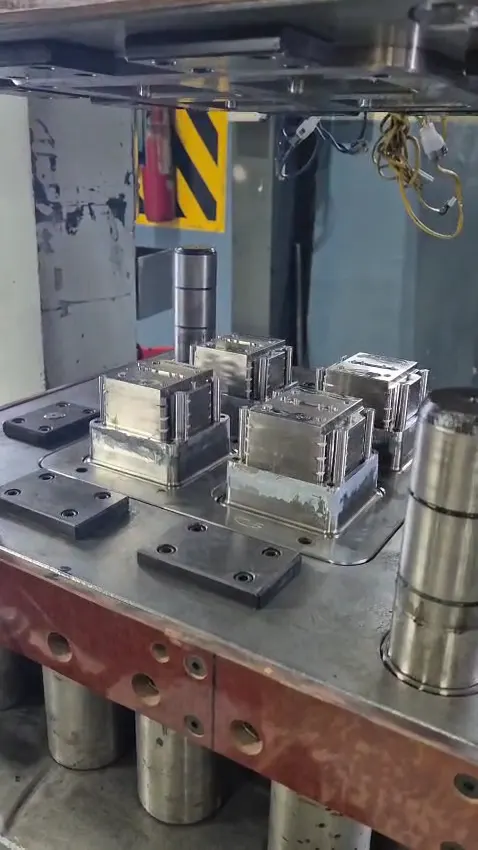
The platens are the flat plates the mould is clamped to. The mould’s footprint must fit within them, with room for clamps, heater connections, thermocouple wiring and lifting. Check:
- Platen length and width (and any tie-rod or column spacing on four-column presses).
- Mounting pattern: T-slots or tapped holes.
- Whether the mould will be centred so the load is even.
Large SMC enclosure moulds often need big platens even when the tonnage is moderate.
3. Daylight, stroke and shut height
- Daylight is the maximum opening between the platens.
- Stroke is how far the moving platen travels.
- Shut height is the mould height when closed.
The press must open enough so that, with the mould installed, the operator can load the charge and remove the part safely, and ejectors can push parts clear. Deep parts like boxes and battery enclosures need more opening. A common mistake is a mould that fits closed but does not leave enough opening for loading.
4. Speed and pressure control
Thermoset moulding needs control at each stage:
- Fast approach to save cycle time.
- Slow pressing speed when the mould touches the charge, so air escapes and fibres are not damaged.
- Pressure build-up and hold during cure, with stable pressure.
- Breathing (degassing) for some materials like phenolic: a short opening to release gases.
- Parallelism control on large presses so the mould closes evenly.
Modern presses with proportional hydraulics or servo control give repeatable cycles, which means consistent parts.
5. Ejection
Most compression moulds use the press’s ejection system (hydraulic ejector cylinders, sometimes top and bottom) to push the part out. Check the ejector position, stroke and force so the mould’s ejector plate can be connected correctly.
6. Heating
The mould is usually heated by its own cartridge heaters with temperature controllers, or by heated platens (electric, steam or oil). Check:
- Electrical supply and controller zones for mould heaters.
- Whether the platens are heated or need insulation boards.
- Thermocouple types and connectors.
7. Safety and automation
Look for light curtains, two-hand controls, guards, emergency stops and safety valves. For volume production, consider charge loading aids and part removal automation.
Compression moulding press checklist to share with your toolmaker
When you request a quote for a new compression mould, send:
| Item | Why it matters |
|---|---|
| Press make and tonnage | Checks that the part can be moulded without flashing |
| Platen size and mounting pattern | Fixes the mould footprint and clamping |
| Daylight, stroke and shut height | Fixes mould height and opening for loading |
| Ejection type, position and stroke | Connects the mould’s ejector system |
| Heating: platen or mould heaters, supply voltage, controller zones | Sets heater layout and wiring |
| Clamping method | Decides clamp slots on the mould |
| Speed control features | Affects venting and closing design |
Our free RFQ checklist for new compression moulds includes all of these fields.
New press or existing press?
If you already own presses, design the mould for them. If you are buying a press for a new product, decide the part and mould concept first, then buy the press. A DFM review will give you the projected area, mould size and opening needed, so you buy the right press once.
Free DFM review
Planning a mould for this part?
Send your 3D model or drawing, material and annual volume. Our engineers reply within one working day.
Frequently asked questions
How do I calculate compression moulding press tonnage?
Tonnage depends on projected area, material moulding pressure, part depth and your safety margin. Use your material supplier’s pressure range and your company’s standards, and ask your toolmaker to check it in a DFM review.
What is daylight in a compression press?
The maximum opening between the press platens. It must allow the installed mould to open enough for loading and part removal.
Do compression moulds need heated platens?
Not always. Many thermoset compression moulds have their own cartridge heaters and controllers. Others use heated platens. The mould and press must be planned together.
What press is used for SMC moulding?
Usually a high-tonnage hydraulic press with large platens, fast approach and slow pressing speed control, and parallelism control for large parts.
Why does my mould flash even on a large press?
Flash is often caused by a worn shear edge, excess charge weight or uneven closing, not only by low tonnage. Our mould repair team can help diagnose it.
Can Prime Tools design a mould for my existing press?
Yes. Every mould we build is designed around the customer’s press details.

Written by the Prime Tools engineering team
Compression mould makers in MIDC Ahilyanagar, Maharashtra, since 2015. We design and build moulds for SMC, DMC/BMC, Bakelite, melamine and urea parts, and repair die casting dies. About us
Keep reading
Processes
Compression Moulding of Rubber vs Thermosets vs Composites and Carbon Fibre
How compression moulding differs for rubber, thermosets (SMC, DMC, Bakelite) and composites: materials, temperatures and mould design.
5 min read · Read article →
Processes
How the Sheet Moulding Compound (SMC) Process Works, Step by Step
The sheet moulding compound (SMC) process from paste mixing and sheet making to maturation, charge cutting, moulding and finishing, with tooling tips.
6 min read · Read article →
Processes
Compression Moulding Explained: Process, Advantages and Limitations
How compression moulding works step by step, the materials it uses, its advantages and disadvantages, and what makes a good compression mould.
6 min read · Read article →