
Compression Moulding of Rubber vs Thermosets vs Composites and Carbon Fibre
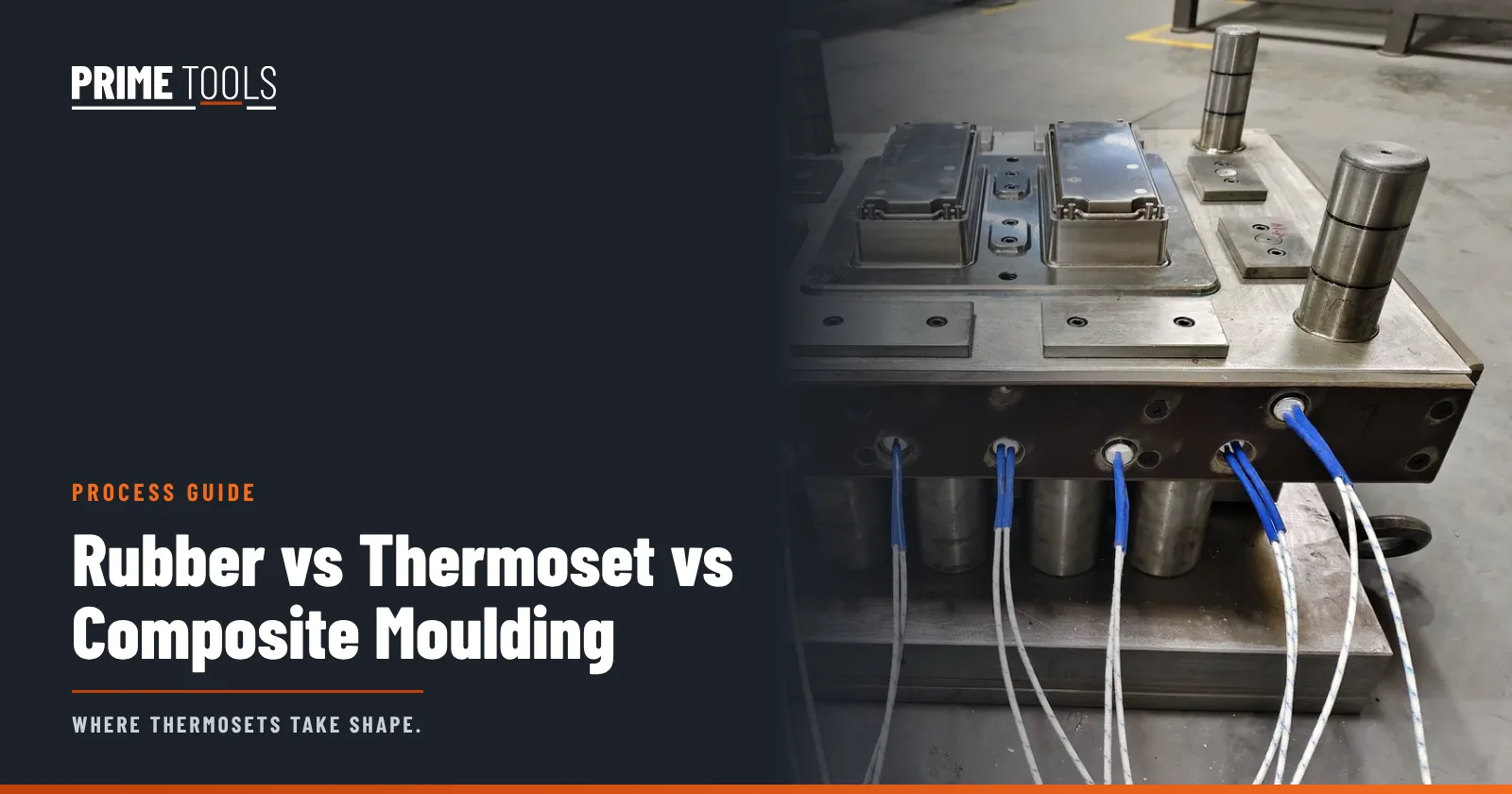
Compression moulding is used for three very different families of material: rubber (elastomers that are vulcanised), thermosets (SMC, DMC/BMC, phenolic, melamine and urea that crosslink into rigid parts), and advanced composites such as carbon fibre prepreg and glass mat thermoplastics. The press and the principle are the same: place a charge, close a heated mould, apply pressure. But temperatures, pressures, cycle times and mould design differ a great deal.
At Prime Tools our core work is thermoset compression moulds. Because buyers often compare processes, this guide explains all three side by side so you know what kind of mould and toolmaker your part needs.
The three families at a glance
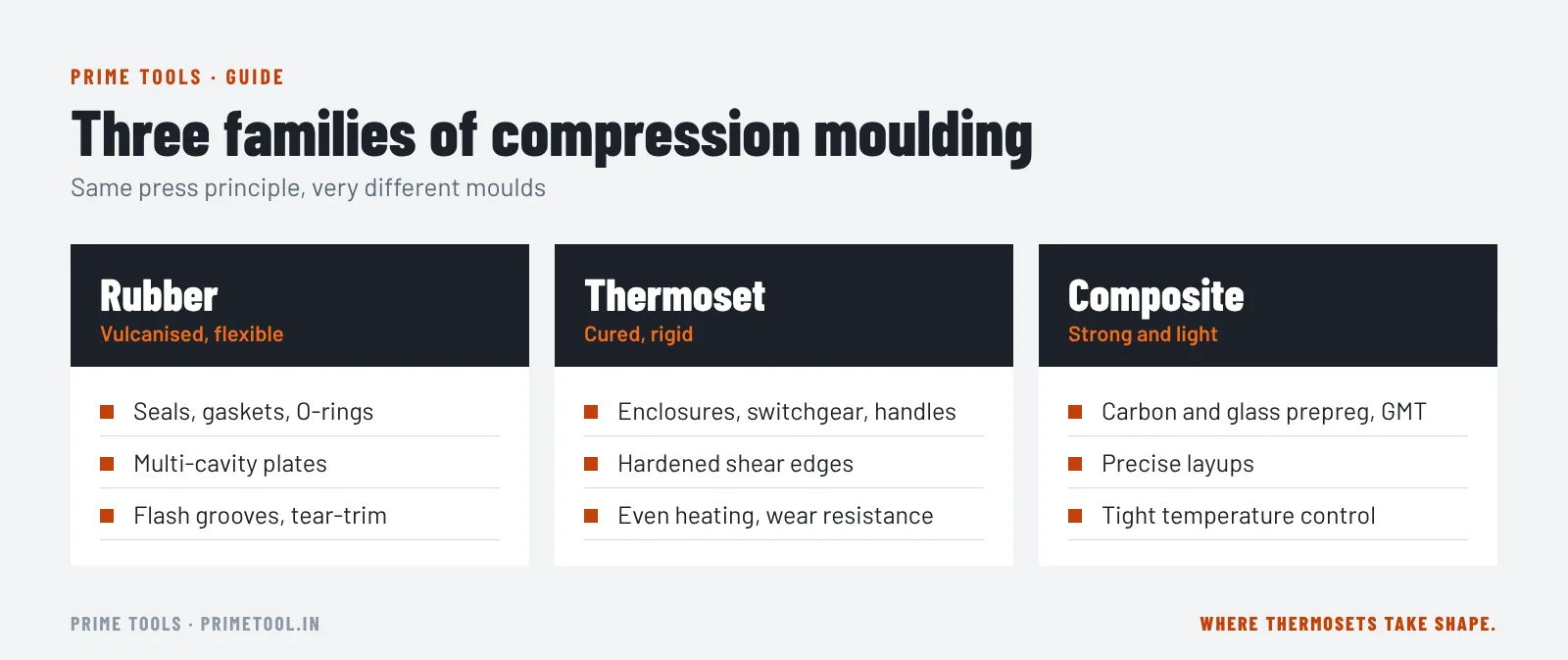
| Rubber | Thermoset (SMC, DMC, phenolic, melamine) | Composites / carbon fibre | |
|---|---|---|---|
| Final part | Flexible, elastic | Rigid, hard | Rigid, very strong and light |
| Reaction | Vulcanisation (crosslinking) | Curing (crosslinking) | Curing (thermoset prepreg) or melting/cooling (thermoplastic composites) |
| Charge form | Pre-forms, strips, blanks | Sheet (SMC), dough (DMC), powder or tablets | Prepreg plies, SMC-carbon, GMT sheets |
| Mould temperature | Roughly 150 to 200 °C (compound dependent) | Roughly 140 to 170 °C for polyester; higher for phenolic | Depends on resin system; often 120 to 180 °C |
| Flash control | Flash grooves, tear-trim | Hardened shear edge | Shear edge or pinch-off, trimmed later |
| Typical parts | O-rings, gaskets, seals, grommets, bellows | Enclosures, meter boxes, switchgear, handles | Automotive panels, drone and sports parts, brackets |
| Mould focus | Many cavities, venting, demoulding flexible parts | Shear edge, even heating, wear resistance | Layup accuracy, thermal control, surface finish |
Rubber compression moulding
Rubber compression moulding is the oldest and simplest rubber process. A pre-weighed pre-form of uncured rubber compound is placed in each cavity. The heated mould closes and the rubber flows and vulcanises. After cure the flexible parts are stripped out, often by hand or with air.
Typical parts: O-rings, flat gaskets, oil seals, grommets, diaphragms, bushes, bellows, rubber-to-metal bonded parts and keypads.
Mould features: multi-cavity plates, overflow (flash) grooves around each cavity, tear-trim edges so flash breaks off cleanly, and good venting. Because rubber is flexible, some undercuts can be stripped without side actions.
Pros: low tooling cost, low waste, good for large or thick rubber parts and low volumes. Cons: more flash than injection moulding and longer cycles.
Thermoset compression moulding
This is our speciality. A charge of SMC, DMC/BMC, phenolic, melamine or urea is placed in a heated steel mould. Under pressure the material flows, fills the cavity and cures into a rigid part. A hardened shear edge between the two mould halves controls flash.
Typical parts: electrical enclosures and meter boxes (SMC), switchgear and lamp holders (DMC/BMC), handles and electrical parts (phenolic), tableware and wiring accessories (melamine and urea).
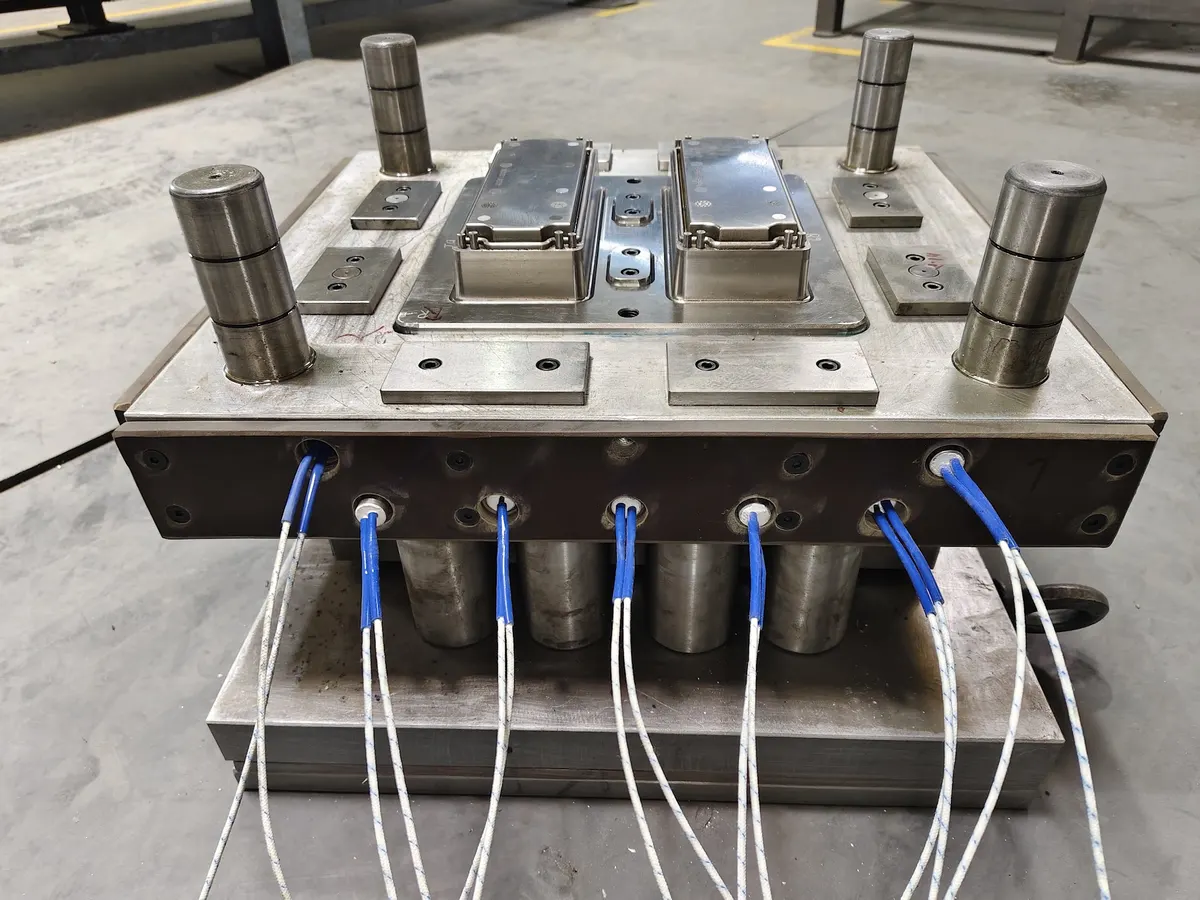
Mould features: through-hardened tool steel cavity and core, precise shear edges, cartridge heaters with thermocouples, ejector systems, guide pillars and support pillars, polish or chrome plating.
Read the full guide: compression moulding explained, or see our compression moulds.
Composite and carbon fibre compression moulding
Composite compression moulding covers several processes:
- Prepreg compression moulding: carbon or glass fibre fabric pre-impregnated with resin is cut, stacked in a specific layup, placed in a matched metal mould and cured under pressure. It gives very high strength-to-weight parts with fast cycles compared with autoclave curing.
- Carbon SMC and forged composites: chopped carbon fibre in resin, pressed like SMC, giving a distinctive marbled look and complex shapes.
- GMT and LFT (thermoplastic composites): glass mat thermoplastic sheets are heated and pressed in a cooler mould. Used for automotive underbody shields and seat structures.
- Headliner compression moulding: automotive headliners are formed by pressing heated fibre or foam composite layers in a mould.
Mould features: high accuracy and surface finish, very even temperature (sometimes with oil heating), shear edges or pinch-off edges, and robust guiding for precise thickness control.
How to choose the right process and toolmaker
- Is the part flexible? If yes, it is rubber. Look for a rubber mould specialist.
- Is it rigid, heat resistant, electrical or outdoor? It is a thermoset. That is our core work.
- Is extreme strength-to-weight the priority (sports, aerospace, premium automotive)? Consider carbon or glass composites.
- What volume? Compression suits low to medium volumes for all three; for very high volumes of small parts, injection variants may be better.
- What press do you have? Tonnage, platen size and heating decide what you can mould. Read our compression moulding press guide.
Choosing the right material within each family
Rubber: NBR for oil resistance, EPDM for weather and water, silicone for high temperature and food contact, FKM (Viton) for fuels and chemicals, natural rubber for mechanical strength and resilience. Each compound has its own cure temperature and shrinkage, so the mould is sized for that compound.
Thermosets: SMC for large strong panels and enclosures, DMC/BMC for compact electrical parts, phenolic for heat and low smoke, melamine and urea for hard, light-coloured surfaces. Read SMC vs BMC and our DMC guide.
Composites: carbon fibre prepreg for maximum stiffness and lightness, glass prepreg for lower cost, carbon SMC for complex shapes, GMT/LFT for tough, recyclable automotive structures.
Mould steel and surface choices
Rubber moulds often use pre-hardened or through-hardened steels with chrome plating for release. Thermoset moulds need through-hardened tool steel because glass fibre and fillers are abrasive, plus polish and often hard chrome. Composite moulds need high-polish surfaces and very stable steel so the thickness stays exact. In all three, even heating and accurate guiding decide part quality.
Free DFM review
Planning a mould for this part?
Send your 3D model or drawing, material and annual volume. Our engineers reply within one working day.
Frequently asked questions
What is rubber compression moulding?
A process where uncured rubber pre-forms are placed in a heated mould, compressed and vulcanised into seals, gaskets and other flexible parts.
What is the difference between rubber and thermoset compression moulding?
Rubber parts stay flexible after vulcanising; thermoset parts become rigid and hard. Moulds differ in flash control, heating and wear resistance.
Can carbon fibre be compression moulded?
Yes. Carbon fibre prepreg and carbon SMC are compression moulded in matched metal moulds to make strong, light parts quickly.
What is headliner compression moulding?
The forming of automotive roof headliners by pressing heated layers of fibre, foam and fabric in a shaped mould.
Can the same mould be used for rubber and SMC?
No. Shear edges, heating, flash control and steel selection are designed for each material.
Does Prime Tools make rubber moulds?
Our focus is thermoset compression moulds (SMC, DMC/BMC, phenolic, melamine, urea) and die casting mould repair and inserts. Contact us to discuss your part.

Written by the Prime Tools engineering team
Compression mould makers in MIDC Ahilyanagar, Maharashtra, since 2015. We design and build moulds for SMC, DMC/BMC, Bakelite, melamine and urea parts, and repair die casting dies. About us
Keep reading
Processes
Choosing a Compression Moulding Press: Tonnage, Platen Size, Daylight and More
What to check when choosing a compression moulding press: tonnage, platen size, daylight, speed control, ejection and heating, and how it must match the…
5 min read · Read article →
Processes
How the Sheet Moulding Compound (SMC) Process Works, Step by Step
The sheet moulding compound (SMC) process from paste mixing and sheet making to maturation, charge cutting, moulding and finishing, with tooling tips.
6 min read · Read article →
Processes
Compression Moulding Explained: Process, Advantages and Limitations
How compression moulding works step by step, the materials it uses, its advantages and disadvantages, and what makes a good compression mould.
6 min read · Read article →