
FRP Manhole Covers: How They Are Made, Load Classes, Sizes and FRP vs Cast Iron vs RCC
An FRP manhole cover is a cover made of fibre-reinforced plastic, usually glass-fibre polyester moulded from SMC (sheet moulding compound) in a heated steel compression mould. FRP covers are much lighter than cast iron, do not rust, are electrically non-conductive and have no scrap value, which makes them popular for theft-prone areas, telecom and power cable chambers, water and sewer lines, and footpaths.
Manhole covers are one of the most searched products in our industry in India. This guide explains how FRP covers are made, the load classes you need to know, common sizes, what drives price, and how FRP compares with cast iron, RCC and SFRC covers. We write it as mould makers: Prime Tools builds the compression moulds for manhole covers that cover manufacturers use to produce SMC/FRP covers and frames.
How FRP / SMC manhole covers are made
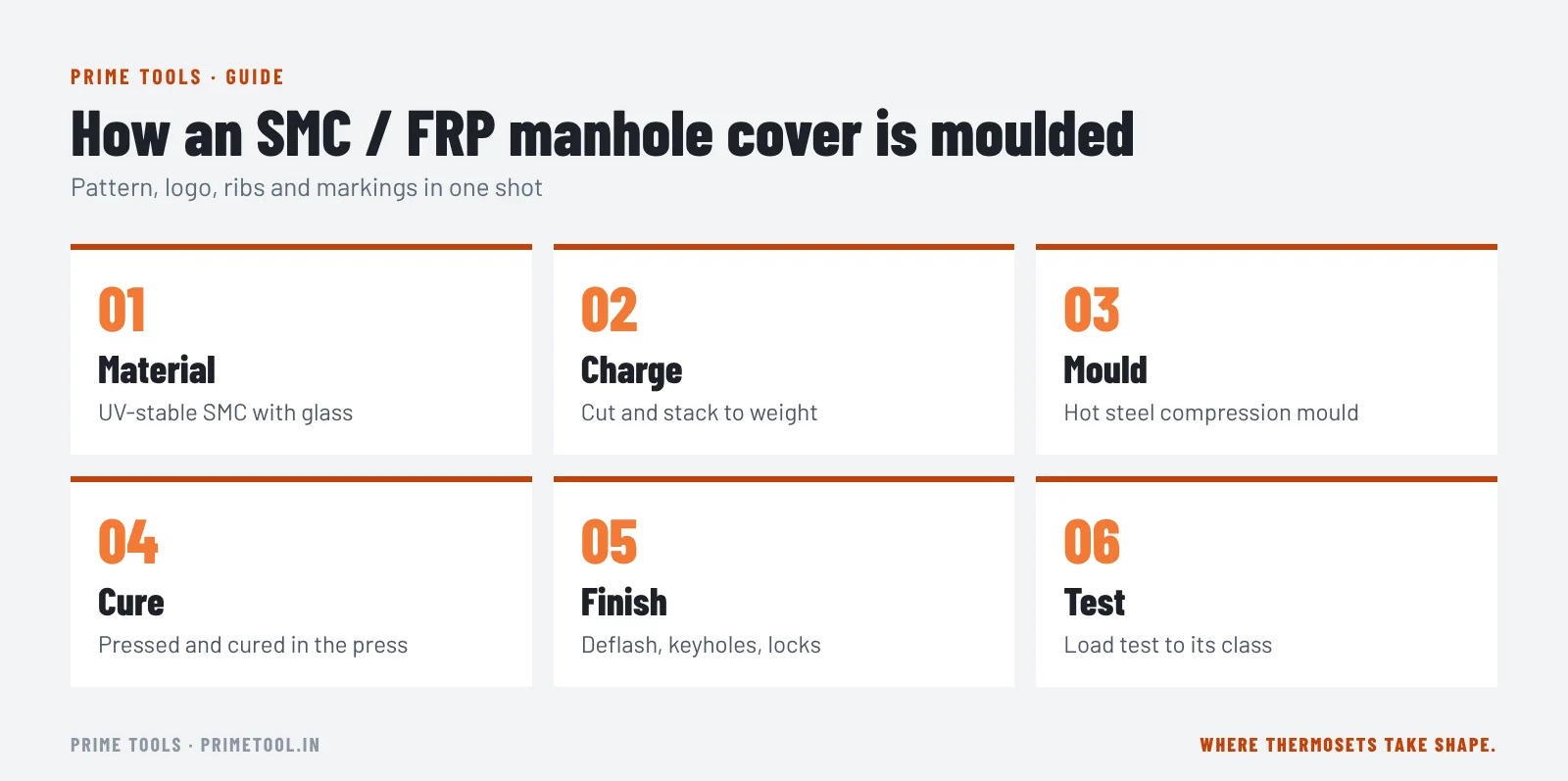
- Material: SMC sheet with glass fibre, polyester or vinyl ester resin, filler and UV-stabilised pigment. Some covers also use BMC for the frame or for smaller covers.
- Charge: the SMC is cut and stacked to a precise weight. For heavy-duty covers, extra reinforcement may be placed in the charge.
- Moulding: the charge goes into a heated steel compression mould (typically around 140 to 160 °C) in a high-tonnage press. The material flows into the top face pattern and the ribs underneath.
- Cure and eject: after cure, the cover is ejected and placed on a fixture to keep it flat while it cools.
- Finishing: flash removal, lifting key holes, logos and markings (moulded in), and optional locking features.
- Testing: sample covers are load tested to the specified class.
The anti-skid top pattern, logo, text, load class marking and ribs are all moulded in one shot, which is why the mould design matters so much.
Manhole cover load classes (EN 124)
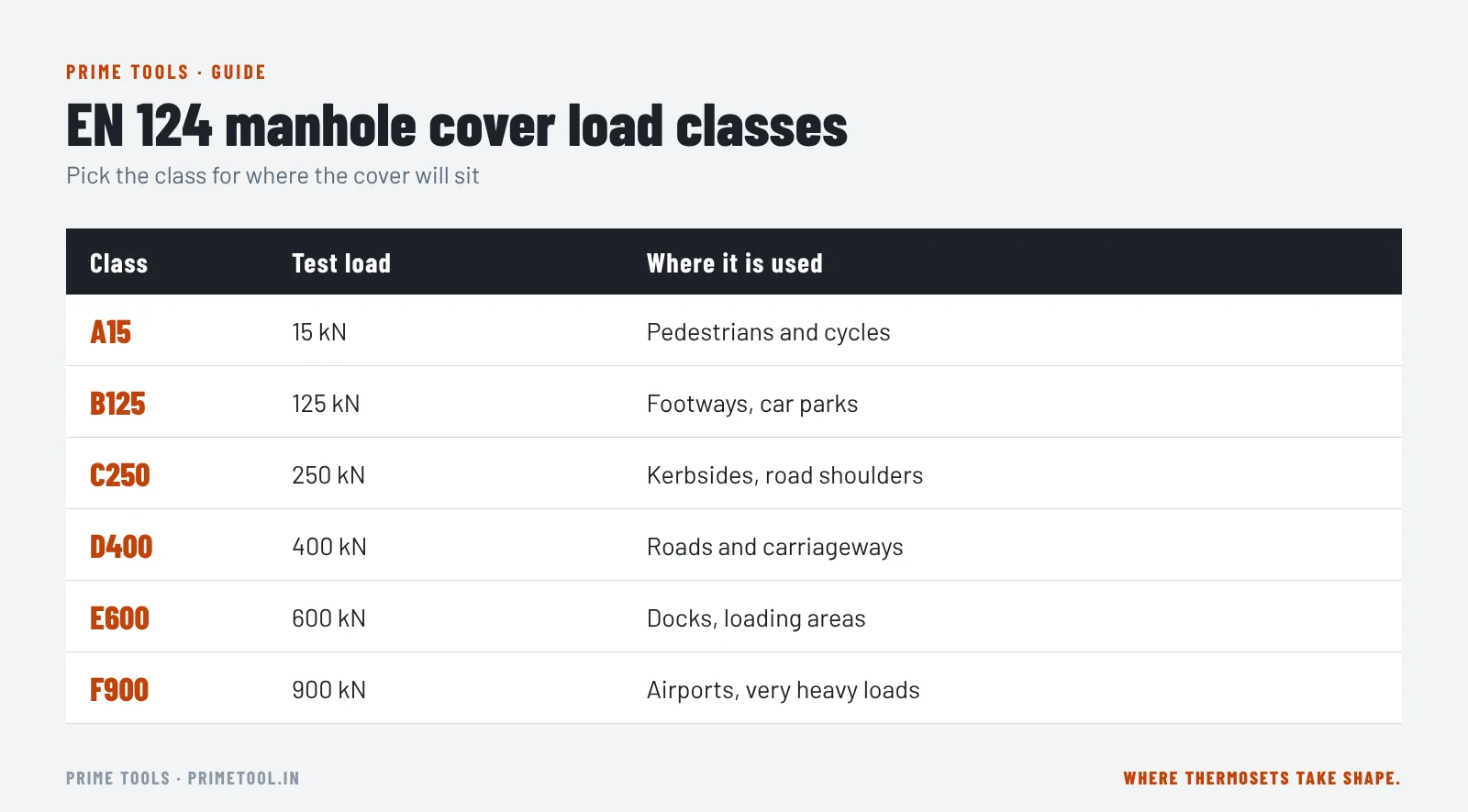
Most specifications in India and abroad refer to the European standard EN 124 load classes. The class is the test load the cover must withstand:
| Class | Test load | Typical use |
|---|---|---|
| A15 | 15 kN | Pedestrian and cycle areas, gardens |
| B125 | 125 kN | Footways, pedestrian zones, car parks |
| C250 | 250 kN | Kerbsides, road shoulders |
| D400 | 400 kN | Roads and carriageways |
| E600 | 600 kN | Docks, loading areas, industrial yards |
| F900 | 900 kN | Airports and very heavy loads |
FRP/SMC covers are common in A15 to D400 depending on design and thickness. For E600 and F900, ductile iron is usually specified. Always check the project specification; Indian projects may also refer to IS standards for cast iron (IS 1726) or concrete covers.
Common manhole cover sizes
Covers are described by their clear opening (the hole size) and overall frame size. Common clear openings include:
- Square: 300 × 300, 450 × 450, 600 × 600 mm
- Rectangular: 450 × 600, 600 × 750, 600 × 900 mm and larger multi-part covers for cable chambers
- Round: 500, 560, 600 mm diameter and above
Sizes differ by supplier and project. The frame sits in the chamber’s top, and the cover sits in the frame. A good fit between cover and frame stops rocking and noise.
FRP vs cast iron vs RCC vs SFRC covers
| FRP / SMC | Cast iron / ductile iron | RCC (precast concrete) | SFRC (steel-fibre concrete) | |
|---|---|---|---|---|
| Weight | Lightest | Heaviest | Heavy | Heavy |
| Corrosion | Does not rust | Rusts unless coated | Rebar can corrode | Good resistance |
| Theft risk | Very low (no scrap value) | High (scrap metal) | Low | Low |
| Electrical | Non-conductive | Conductive | Non-conductive | Slightly conductive (steel fibre) |
| Load classes | Light to medium-heavy | All, including heaviest | Light to medium | Light to medium-heavy |
| Handling | Easy, one or two people | Lifting tools needed | Lifting tools needed | Lifting tools needed |
| Appearance | Moulded patterns, logos, colours | Cast patterns | Plain | Plain |
Choose FRP for theft-prone areas, cable and telecom chambers, water supply lines, footpaths, gardens, petrol pumps, and anywhere workers lift covers often. Choose ductile iron for very heavy traffic classes. RCC and SFRC are economical for municipal sewer lines where weight is not a concern.
What decides FRP manhole cover price?
Buyers searching “frp manhole cover price” find a wide range. Price depends on:
- Load class and thickness: a D400 cover uses far more material than an A15 cover.
- Size: material weight goes up with the square of the opening size.
- Material grade: glass content, resin type (polyester vs vinyl ester), UV stabilisers.
- Frame included or not: cover-only vs cover-and-frame set.
- Locking and features: locks, hinges, gaskets, custom logos.
- Volume: larger orders spread the mould cost.
For a manufacturer, the mould is the main one-time investment. A well-designed mould with family cavities (cover and frame), interchangeable logo inserts and good heating can make many sizes and markings for years.
What makes a good manhole cover mould
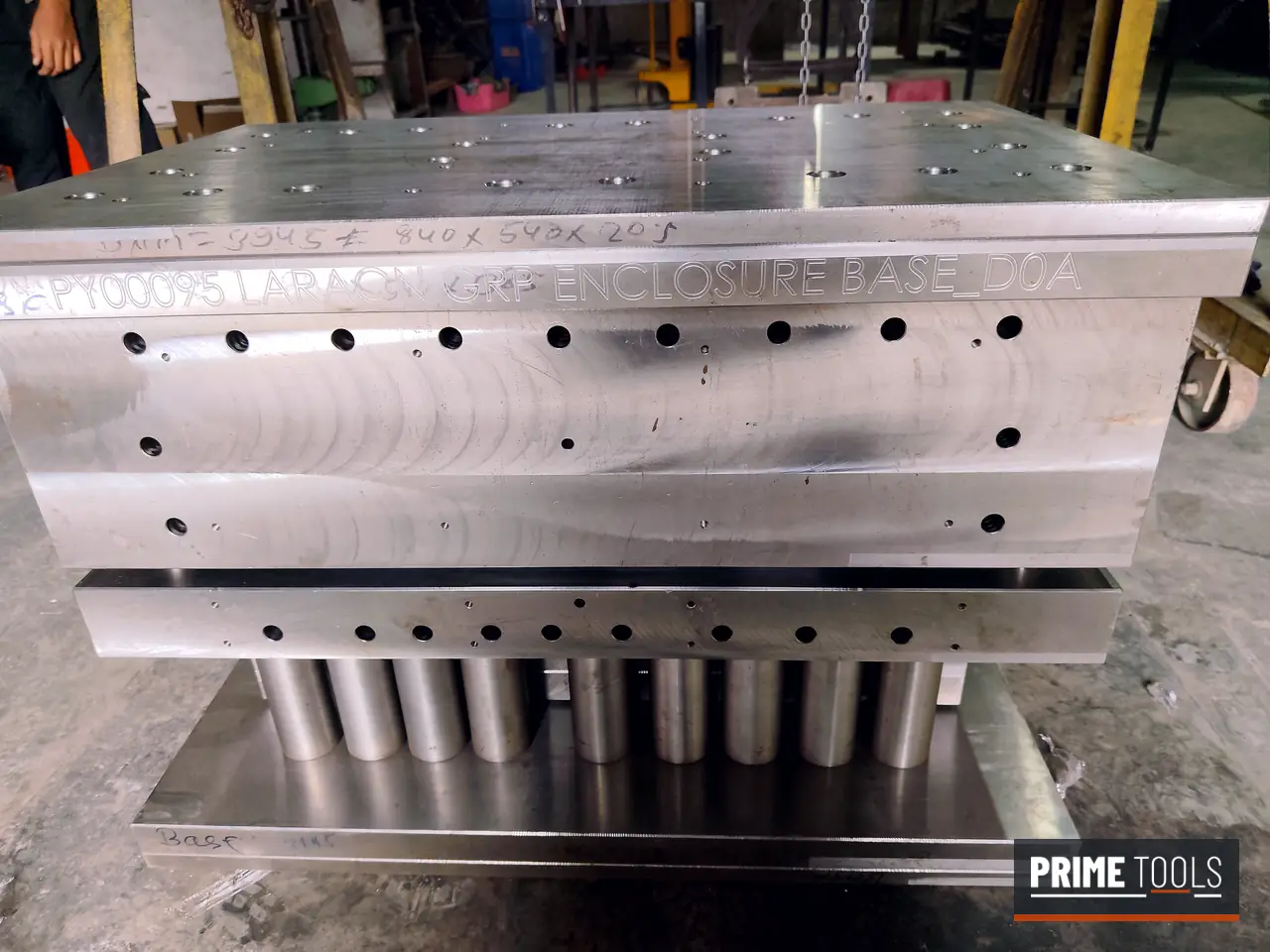
- Rib design: deep ribs give strength without heavy weight. The mould must fill and release deep ribs cleanly, with enough draft.
- Shear edges: a long perimeter shear edge controls flash. Hardened and fitted precisely, it keeps deflashing low.
- Logo and text inserts: interchangeable inserts let one mould carry different client logos, load classes and years.
- Even heating: large flat parts warp if one area cures faster than another.
- Stiff construction: high tonnage on a large area must not bend the plates.
- Ejection: spread ejection so the cover comes out flat.
We cover these in our SMC moulds and compression moulds pages, and our DFM service checks rib design and press tonnage before steel is cut.
Tips for buyers specifying FRP covers
- State the load class, clear opening, frame type and quantity.
- Ask for load test reports for the exact class and size.
- Check for UV stabilisation if covers are in direct sun.
- Ask about locking if tampering is a concern.
- For branded covers, ask whether your logo is a moulded insert (durable) or a sticker (not durable).
Tips for manufacturers setting up FRP cover production
- Start with your most common sizes and classes; design moulds with family layouts where it makes sense.
- Match the mould to your press tonnage and platen size. Our article on choosing a compression moulding press explains what to check.
- Plan logo inserts so you can serve several government or utility clients from one mould.
- Budget for maintenance: shear edges and surfaces need periodic rework. See our mould repair service.
Free DFM review
Planning a mould for this part?
Send your 3D model or drawing, material and annual volume. Our engineers reply within one working day.
Frequently asked questions
What is an FRP manhole cover?
A manhole cover made of fibre-reinforced plastic, usually glass-fibre polyester moulded from SMC. It is light, corrosion-free, non-conductive and has no scrap value.
Is an FRP manhole cover strong enough for roads?
FRP covers are made in classes up to D400 for roads, depending on design and thickness. For very heavy loads (E600, F900), ductile iron is usually used.
What is the difference between FRP and SMC manhole covers?
SMC is the material (sheet moulding compound), and FRP is the general term (fibre-reinforced plastic). Most “FRP manhole covers” on the market are SMC moulded.
What are standard manhole cover sizes?
Common clear openings are 450 × 450, 600 × 600, 450 × 600 and 600 × 900 mm, plus round 500 to 600 mm diameter. Sizes vary by project.
Why choose FRP over cast iron manhole covers?
Lower weight, no rust, no theft for scrap, electrical safety and lower handling effort. Cast iron is still preferred for the heaviest traffic loads.
Can you make a mould for my manhole cover design?
Yes. Prime Tools designs and builds SMC compression moulds for covers and frames. Send your drawing, load class and press details for a free DFM review.

Written by the Prime Tools engineering team
Compression mould makers in MIDC Ahilyanagar, Maharashtra, since 2015. We design and build moulds for SMC, DMC/BMC, Bakelite, melamine and urea parts, and repair die casting dies. About us
Keep reading
Products
Battery Box for Inverters: Why SMC and BMC Are Used, and What to Look For
Inverter battery boxes compared: SMC/BMC, plastic and metal. Heat, acid and fire resistance, ventilation, and how SMC battery boxes are moulded.
5 min read · Read article →
Products
FRP vs GI vs SS Cable Trays: Types, Comparison and How to Choose
Cable tray types (perforated, ladder, raceway) and materials (FRP/GRP, GI, SS, aluminium) compared on corrosion, strength, weight, cost and where each is used.
6 min read · Read article →
Products
SMC Junction Boxes and Electric Meter Boxes: Materials, IP Ratings and Mould Design
SMC junction box, FRP, ABS and metal junction boxes and meter boxes compared: IP ratings, single and three phase boxes, and SMC box moulds.
6 min read · Read article →