
How to Choose a Mould Maker in India: A 15-Point Checklist
To choose a mould maker in India, check five things before price: that they specialise in your process and material, that they do a proper DFM review, which steel and machines they use, whether they trial the mould and give you first-off parts, and whether they will support repairs and maintenance after delivery. A cheap mould that flashes, sticks or cracks costs far more in lost production than the price difference you saved.
India has thousands of mould manufacturers, from small job shops to large tool rooms, across Pune, Mumbai, Ahmedabad, Rajkot, Delhi NCR, Bengaluru, Chennai, Coimbatore and Hyderabad. We are one of them: Prime Tools, in MIDC Ahilyanagar near Pune, specialising in thermoset compression moulds and die casting die repairs. This checklist is what we would want buyers to ask us, and any other toolmaker.
The 15-point mould maker checklist
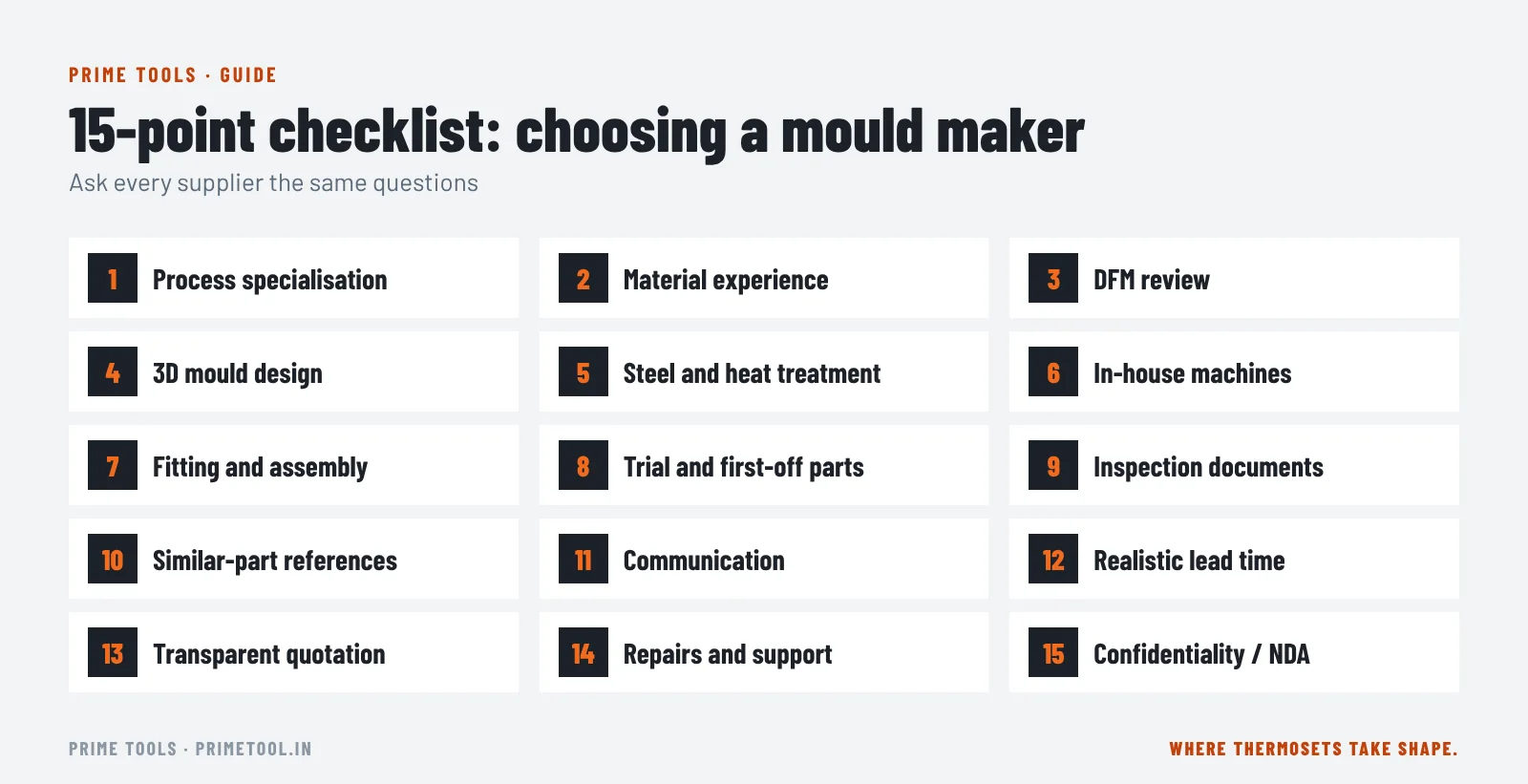
1. Process specialisation
“Mould maker” covers very different trades: plastic injection moulds, thermoset compression moulds, die casting dies, rubber moulds, blow moulds and press tools. Ask what share of their work is in your process. A great injection tool room may not understand shear edges and heating for SMC.
2. Material experience
Have they built moulds for your exact material, for example SMC, DMC/BMC, phenolic, melamine, PP, nylon or aluminium? Each behaves differently and wears steel differently.
3. DFM review
A good toolmaker reviews your part before quoting a final design: wall thickness, draft, radii, ribs, parting line, ejection, inserts and press fit. Ask to see a sample DFM report. You can download ours.
4. Mould design capability
Do they design in 3D (and can they show you the design for approval)? Do they run flow or feasibility studies? See our DFM and mould design approach.
5. Steel and heat treatment
Ask which steel grades they use for cavity, core and plates, the hardness, and who does the heat treatment. Ask for steel certificates.
6. Machines in-house
VMC/CNC machining, EDM (spark erosion), surface and cylindrical grinding, and ideally wire cut and polishing. In-house machines mean better control of quality and lead time. See our capabilities.
7. Fitting and assembly
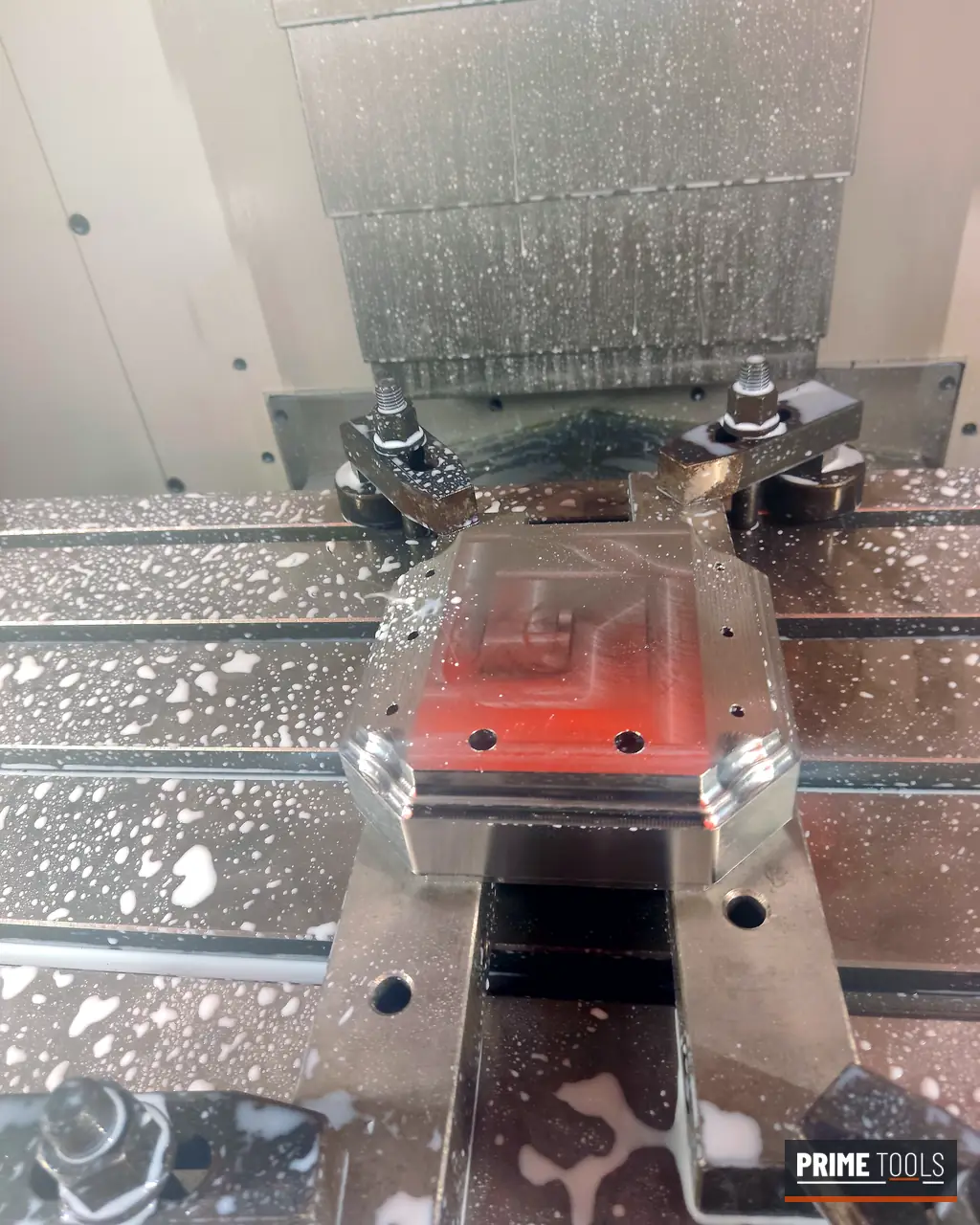
Good moulds are made at the bench as much as on machines. Ask how they fit shear edges, align halves and check heating.
8. Trials and first-off parts
Do they trial the mould on a press and send you first-off parts, photos or video before dispatch? A mould that has not been tried is a risk.
9. Quality checks and documentation
Ask for an inspection report, heater and thermocouple test, and a list of spares. For export, ask about documentation and packing. See our quality and trials page.
10. References with similar parts
Ask to see photos, videos or samples of similar parts (customers’ names are often confidential, which is normal). Our projects page shows our work without naming customers.
11. Communication and project updates
Who is your contact? Will you get regular updates with photos during manufacture? Engineers who answer technical questions quickly save weeks.
12. Lead time realism
Very short lead time promises often mean outsourcing or shortcuts. Ask for a schedule with milestones: design approval, steel arrival, machining, fitting and trial.
13. Transparent quotation
A good quote states steel, hardness, cavities, heating, ejection, standard parts, trial, spares, packing and delivery terms. Compare quotes on the same specification. Our mould costing guide explains what drives price.
14. After-sales support and repairs
Moulds need maintenance. Will the toolmaker repair and modify the mould later? Do they keep the design files? See our mould repair service.
15. Confidentiality
Will they sign an NDA? Do they keep your designs private and avoid showing your parts publicly without permission?
Red flags
- A quote without a steel specification.
- No DFM questions at all before quoting.
- Unwilling to show their tool room or machines (in person or by video).
- No trial before dispatch.
- Prices far below others with the same lead time.
- Showing other customers’ confidential drawings to you.
Does location matter?
Clusters such as Pune, Ahmedabad, Rajkot and Delhi NCR have many tool rooms, and being close helps for visits and trials. But capability, communication and support matter more than distance. Moulds ship well across India and abroad when packed properly. We supply customers across India and export markets from MIDC Ahilyanagar. See export.
Why buyers choose Prime Tools
- Specialists in thermoset compression moulds: SMC, DMC/BMC, phenolic (Bakelite), melamine and urea.
- Free DFM review on every new part.
- In-house VMC, EDM and grinding, with fitting and assembly in our own tool room.
- Mould repair, modification and die casting die inserts to keep existing tools running.
- Working since 2015 for domestic and export customers.
Questions to ask on a factory visit (or video call)
- Can we see a mould for a similar material on the bench or in trial?
- Who designs the mould, and can we talk to them?
- Which work is done in-house and which is outsourced (heat treatment, hard chrome, wire cut)?
- How do you check shear edge fit and heating before trial?
- What does a typical trial report contain?
- What spares do you supply with the mould?
- How quickly can you respond to a breakdown?
How to compare quotes fairly
Put the quotes side by side in a table with the same rows: steel for cavity and core, hardness, number of cavities, heating, ejection, standard parts brand, surface finish, trial, spares, packing, delivery terms and payment terms. Differences in price usually come from one of these rows. A mould built with softer steel or no trial may be cheaper today and more expensive within a year.
Free DFM review
Planning a mould for this part?
Send your 3D model or drawing, material and annual volume. Our engineers reply within one working day.
Frequently asked questions
How do I find a good mould manufacturer in India?
Shortlist toolmakers who specialise in your process and material, ask for DFM, steel specifications, machine lists and trial reports, and compare quotes on the same specification.
Where are most mould makers in India located?
Major clusters include Pune, Mumbai, Ahmedabad, Rajkot, Delhi NCR, Bengaluru, Chennai, Coimbatore and Hyderabad, but capable tool rooms exist in many industrial towns.
What is the difference between a die maker and a mould maker?
Broadly, “dies” shape metal (die casting dies, press tools) and “moulds” shape plastics, thermosets and rubber. Many tool rooms do both.
How long does it take to make a mould?
It depends on size and complexity. Many compression moulds take several weeks to a few months including design, machining, fitting and trial.
Should I always choose the cheapest mould quote?
No. Compare the specification. A cheaper mould with softer steel or no trial often costs more in downtime and repairs.
Does Prime Tools make plastic injection moulds?
Our speciality is thermoset compression moulds and die casting die repairs and inserts. For thermoplastic injection moulds, we can advise what to look for.
Related reading: the 3D software toolmakers use for mould design and die casting vs sand casting vs investment casting.

Written by the Prime Tools engineering team
Compression mould makers in MIDC Ahilyanagar, Maharashtra, since 2015. We design and build moulds for SMC, DMC/BMC, Bakelite, melamine and urea parts, and repair die casting dies. About us
Keep reading
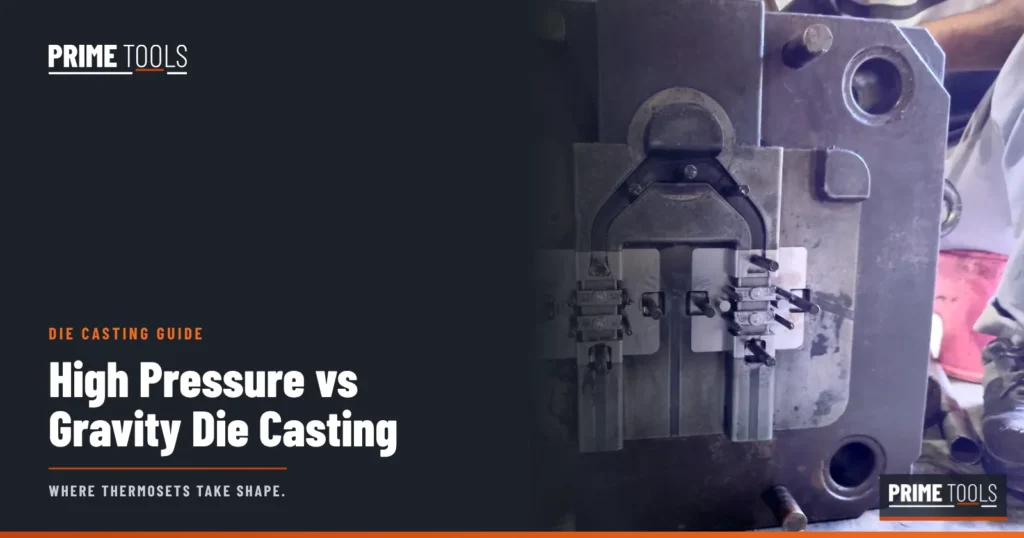
Die casting
High Pressure vs Gravity Die Casting: Process, Dies, Inserts and Maintenance
High pressure vs gravity die casting: how each works, typical parts, die design, die inserts, wear, and how to maintain and repair dies.
6 min read · Read article →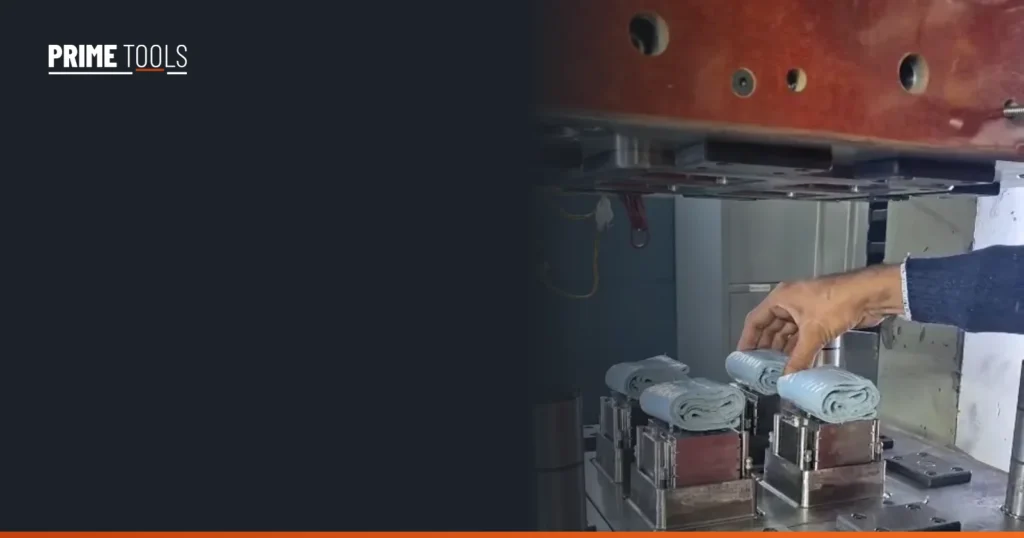
Processes
Compression Moulding Explained: Process, Advantages and Limitations
How compression moulding works step by step, the materials it uses, its advantages and disadvantages, and what makes a good compression mould.
6 min read · Read article →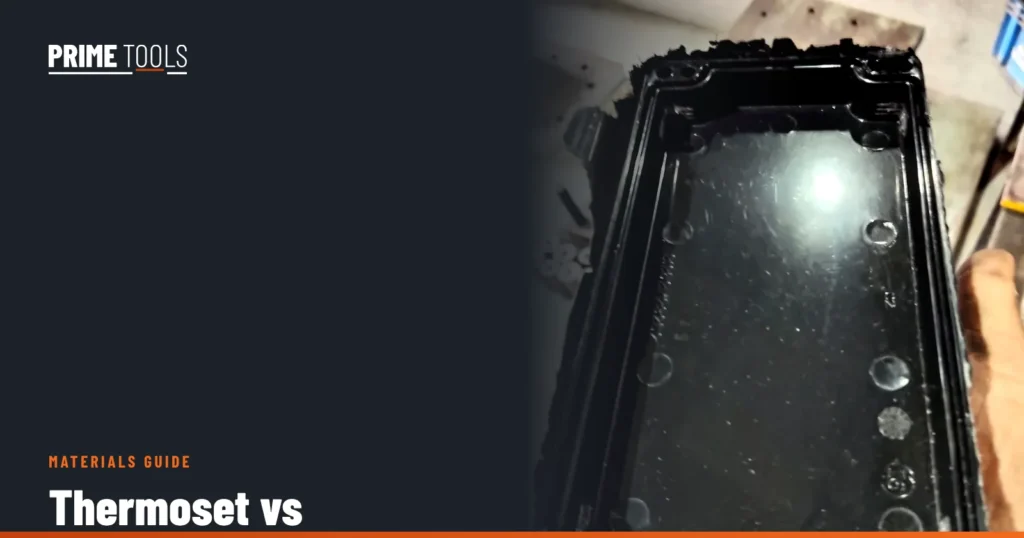
Materials
Thermoset vs Thermoplastic: Which Material Is Right for Your Part?
Thermoset vs thermoplastic explained: how they differ, properties, examples, moulding processes, cost and how to choose the right one for your part.
6 min read · Read article →