
Die Casting vs Sand Casting vs Investment Casting: Which Process Fits Your Part?
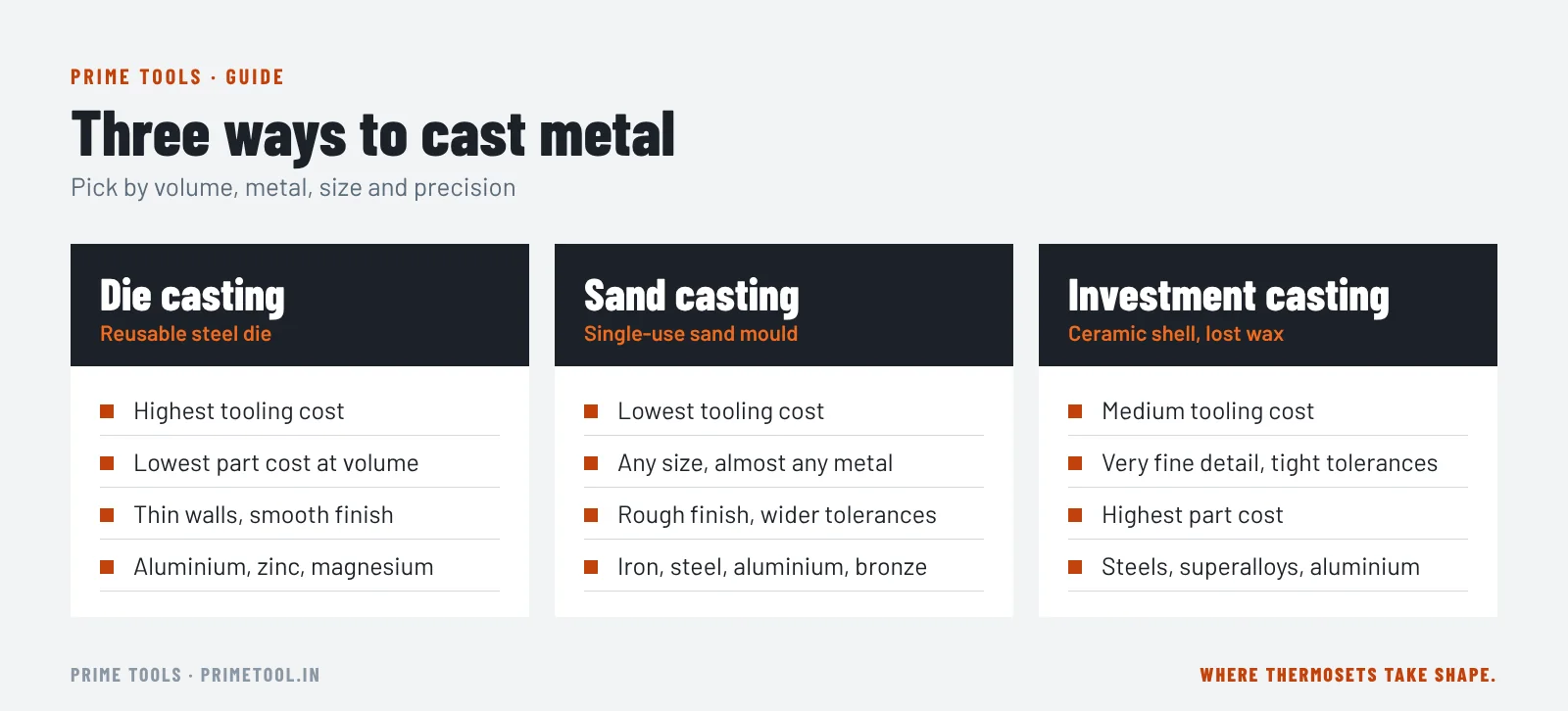
Die casting forces molten metal into a reusable steel die, giving fast, precise, thin-walled parts at high volume, but with high tooling cost and mostly non-ferrous metals. Sand casting pours metal into a single-use sand mould, giving low tooling cost, any size and almost any metal, but rougher surfaces and wider tolerances. Investment casting pours metal into a ceramic shell made around a wax pattern, giving very fine detail and tight tolerances in almost any alloy, at a higher cost per part.
Choosing between them comes down to volume, metal, size, precision and budget. At Prime Tools we repair and make replacement inserts for die casting dies, and we often meet buyers deciding between processes. This guide gives you an honest comparison.
How each process works
Die casting: a steel die with cavity inserts is mounted in a die casting machine. Molten metal is injected (high pressure) or poured (gravity), solidifies, and the casting is ejected. The die is reused for many thousands of shots. Read high pressure vs gravity die casting.
Sand casting: a pattern is pressed into sand bonded with clay or resin to make a mould cavity. Metal is poured in. After cooling, the sand is broken away. A new mould is made for every casting, but the pattern is reused.
Investment casting (lost wax): a wax pattern (often injected into an aluminium tool) is dipped repeatedly in ceramic slurry to build a shell. The wax is melted out, metal is poured into the hot shell, and the shell is broken off.
Comparison table
| Die casting | Sand casting | Investment casting | |
|---|---|---|---|
| Tooling cost | High (steel die) | Low (pattern) | Medium (wax tool) |
| Cost per part at volume | Lowest | Medium | Highest |
| Economic volume | High (thousands to millions) | One-offs to medium | Low to medium |
| Part size | Small to large (machine limited) | Very small to very large | Small to medium |
| Wall thickness | Thin | Thick | Thin to medium |
| Tolerances | Tight | Wide | Very tight |
| Surface finish | Smooth | Rough | Very smooth |
| Metals | Aluminium, zinc, magnesium, some copper | Almost any: iron, steel, aluminium, bronze | Almost any: steels, stainless, superalloys, aluminium |
| Lead time for tooling | Longest | Shortest | Medium |
| Machining needed | Least | Most | Little |
Die casting vs sand casting
Choose die casting when:
- Volumes are high enough to pay back the die.
- The part is aluminium, zinc or magnesium.
- You need thin walls, good surface finish and consistent dimensions.
- You want minimal machining.
Choose sand casting when:
- Volumes are low or the design may still change.
- The part is very large or heavy.
- The metal is cast iron or steel.
- The tooling budget is tight.
A common path: sand cast prototypes and early production, then move to die casting when volumes grow and the design is frozen.
Investment casting vs die casting
Choose investment casting when the part is complex, needs tight tolerances and fine detail, and is in a metal die casting cannot handle (steel, stainless steel, superalloys). Typical parts: turbine blades, valve parts, medical and firearm components, pump impellers.
Choose die casting when the part is non-ferrous and volume is high, because cost per part is much lower and cycles are seconds rather than hours.
Cost: how to compare properly
Do not compare only the part price. Compare total cost over the product’s life:
Total cost = tooling + (part cost × volume) + machining + finishing + scrap
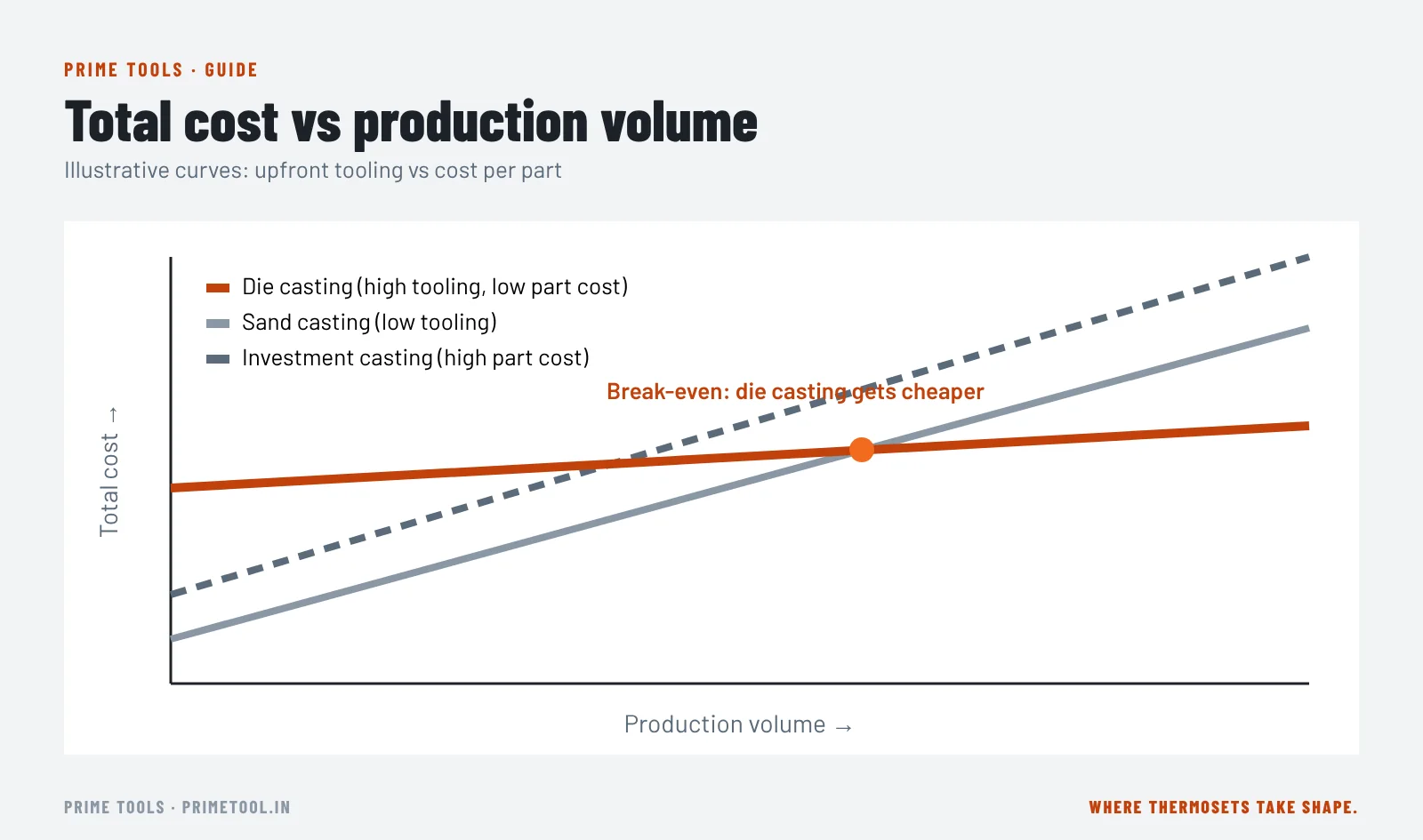
Die casting has the highest upfront tooling but the lowest part and machining cost, so it wins at high volume. Sand casting wins at low volume. Investment casting wins where its precision removes expensive machining in difficult alloys.
The hidden cost in die casting: die life
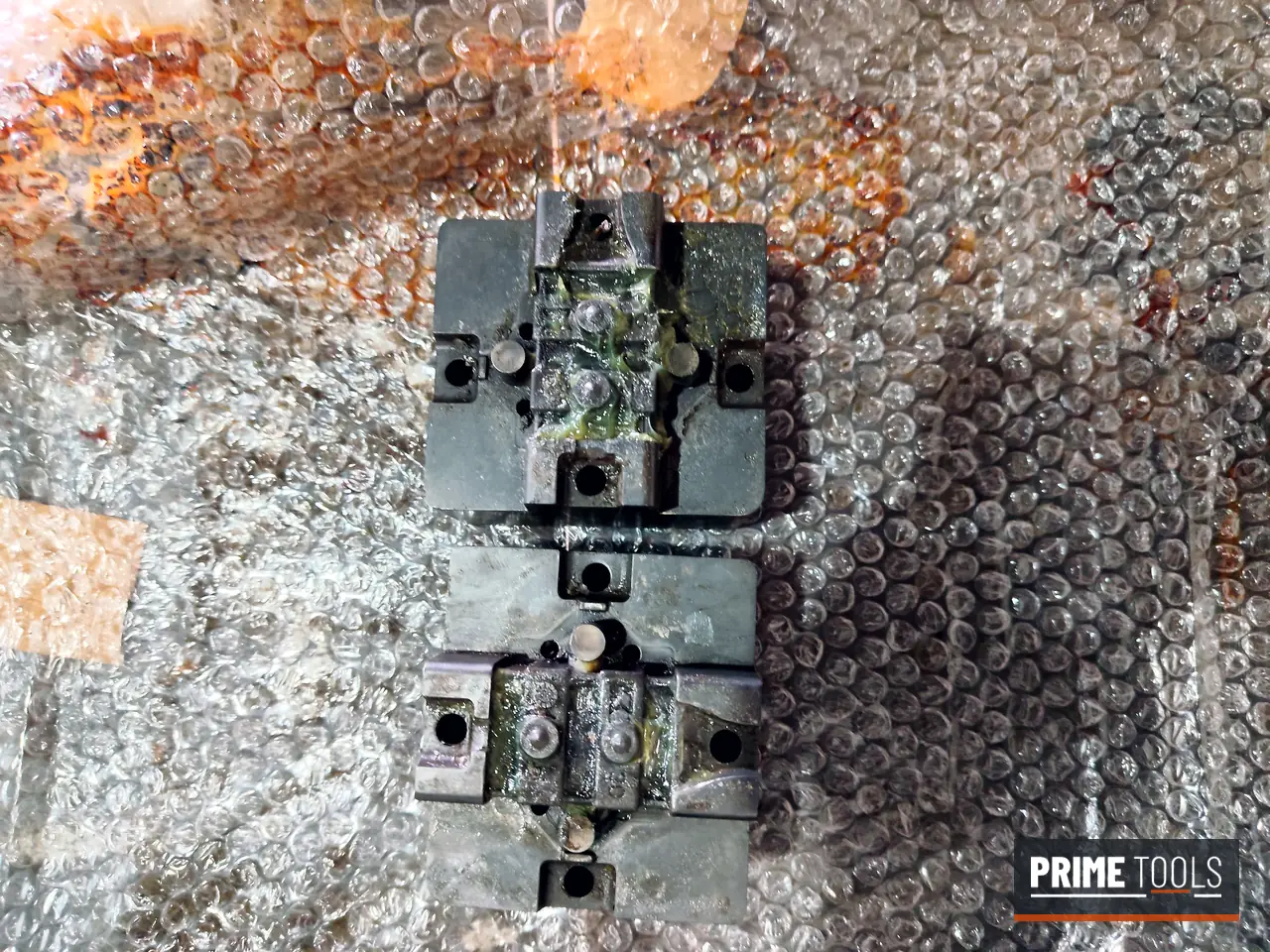
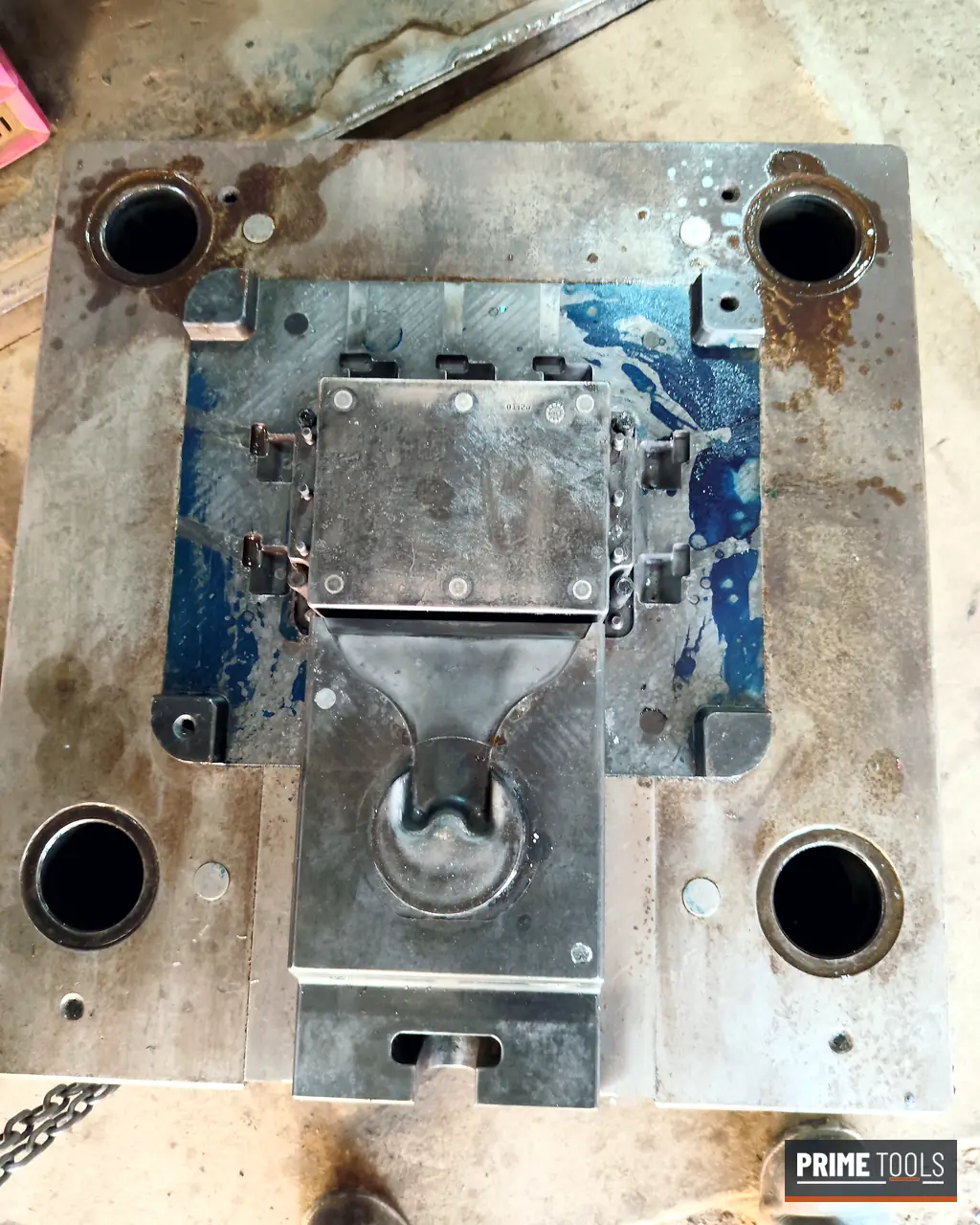
Die casting’s low part cost depends on the die running well. Heat checking, soldering, erosion and cracks will eventually affect quality. Planned maintenance and replacement inserts keep a die productive far longer than running it to failure. That is where we help: die casting moulds, repair and inserts.
What about compression moulding?
If your part is currently a die casting only because it needs strength, heat resistance or a housing shape, a thermoset such as SMC or BMC may be an alternative: no corrosion, electrical insulation, lower weight and often lower tooling cost. It is not right for every part, but worth a look for enclosures, covers and electrical housings. See thermoset vs thermoplastic and our compression moulds.
A quick decision guide
Answer these four questions:
- What metal? Steel or stainless steel rules out die casting: choose sand or investment casting. Aluminium or zinc keeps all three open.
- How many parts per year? Thousands and more favour die casting. Dozens to hundreds favour sand casting. Hundreds to a few thousand of a complex, precise part favour investment casting.
- How big? Very large and heavy parts point to sand casting.
- How precise and smooth? Tight tolerances and fine detail point to die casting (non-ferrous) or investment casting (any alloy).
Examples
- Gearbox housing, aluminium, high volume: high pressure die casting.
- Pump casing, cast iron, a few hundred a year: sand casting.
- Stainless valve part with fine detail: investment casting.
- Aluminium wheel: gravity or low pressure die casting.
- Large machine base: sand casting.
Machining allowance and finishing
Sand castings need the most machining allowance, so add machining cost to every sand-cast quote. Die castings often need only drilling and tapping. Investment castings can be near net shape. Surface treatments such as anodising, powder coating and plating also behave differently on each type, especially on porous die castings.
Free DFM review
Planning a mould for this part?
Send your 3D model or drawing, material and annual volume. Our engineers reply within one working day.
Frequently asked questions
What is the difference between die casting and sand casting?
Die casting uses a reusable steel die and high pressure for fast, precise, thin-walled parts. Sand casting uses a single-use sand mould, suits any size and metal, but is rougher and less precise.
Is die casting cheaper than sand casting?
At high volumes, yes, because part and machining costs are lower. At low volumes, sand casting is cheaper because tooling cost is much lower.
What is the difference between investment casting and die casting?
Investment casting uses ceramic shells around wax patterns for complex, precise parts in almost any alloy. Die casting uses steel dies for fast, high-volume non-ferrous parts.
Can steel be die cast?
Not commonly. Die casting is mainly for aluminium, zinc and magnesium. Steel parts are usually sand or investment cast.
Which casting process gives the best surface finish?
Investment casting and die casting both give smooth surfaces; sand casting is the roughest.
Can Prime Tools help with die casting dies?
Yes. We repair and modify HPDC and GDC dies and make new replacement inserts for them.

Written by the Prime Tools engineering team
Compression mould makers in MIDC Ahilyanagar, Maharashtra, since 2015. We design and build moulds for SMC, DMC/BMC, Bakelite, melamine and urea parts, and repair die casting dies. About us
Keep reading
Buyer guides
How to Choose a Mould Maker in India: A 15-Point Checklist
A checklist for choosing a mould maker in India: capability, DFM, steel, machines, trials, quality, export readiness, cost and red flags.
6 min read · Read article →
Materials
SMC vs BMC: Differences Explained with Real Product Examples
SMC vs BMC compared: composition, fibre length, strength, typical products and how sheet and bulk moulding compounds are moulded.
6 min read · Read article →
Processes
How the Sheet Moulding Compound (SMC) Process Works, Step by Step
The sheet moulding compound (SMC) process from paste mixing and sheet making to maturation, charge cutting, moulding and finishing, with tooling tips.
6 min read · Read article →