
Dough Moulding Compound (DMC): Properties, Uses and How It Is Moulded
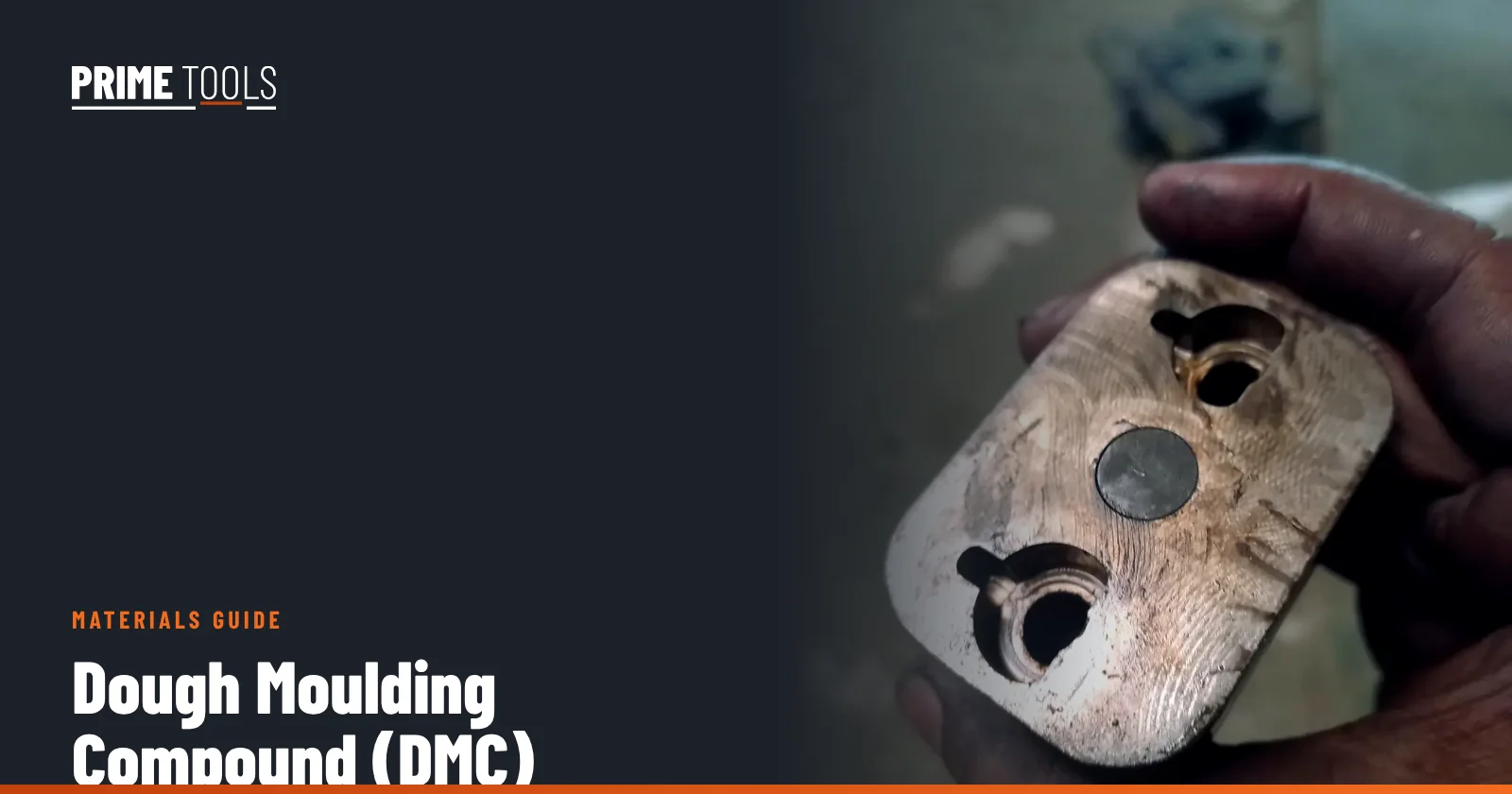
Dough moulding compound (DMC) is a ready-to-mould thermoset material made of unsaturated polyester resin, chopped glass fibre, mineral filler and a curing catalyst, mixed into a putty-like “dough”. It is pressed into shape in a heated steel mould, where it cures into a hard, rigid part that does not melt again. DMC is the material behind many switchgear parts, lamp holders, motor parts, meter components and electrical insulators you use every day.
At Prime Tools we build the steel moulds that shape DMC parts, so we see this material from the toolmaker’s side: how it flows, where it wears a mould, and which design choices make a DMC part easy or painful to produce. This guide explains DMC in plain words, for buyers, design engineers and anyone moving a part from metal or thermoplastic to a thermoset.
What is dough moulding compound made of?
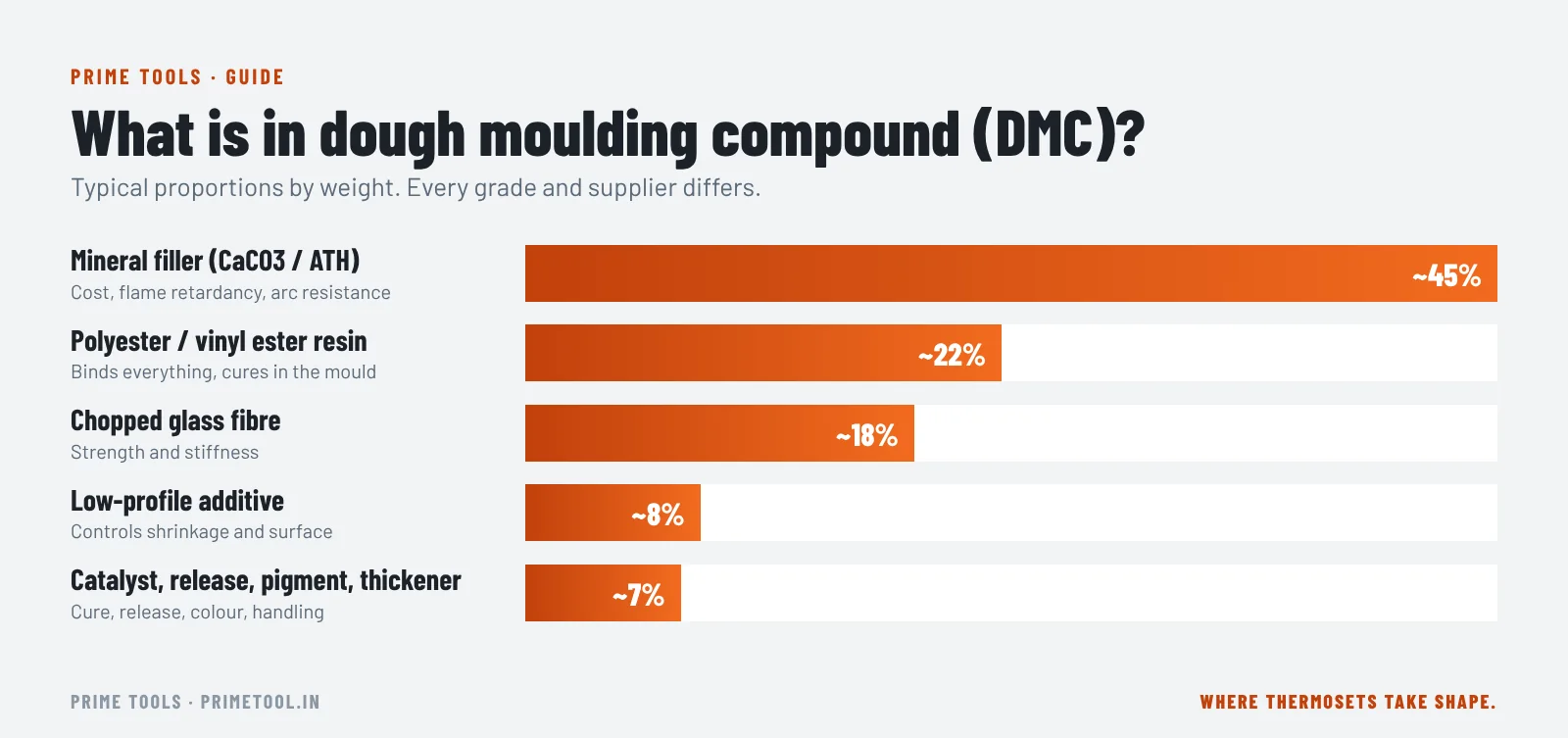
Every DMC formulation is a recipe. The supplier balances the ingredients for strength, flow, colour, flame rating and cost. A typical DMC contains:
- Resin: unsaturated polyester (UP) in most grades. Vinyl ester or epoxy-modified grades are used where chemical resistance or extra toughness is needed.
- Reinforcement: chopped glass fibre, usually a few millimetres to around 12 mm long. Fibre is what gives the cured part its strength and stiffness.
- Fillers: calcium carbonate is common. Alumina trihydrate (ATH) is added for flame retardancy and arc resistance in electrical grades.
- Low-profile additive: a thermoplastic additive that counters resin shrinkage, so the part keeps its dimensions and has a smoother surface.
- Catalyst (initiator): a peroxide that starts the cure when the material is heated in the mould.
- Release agent, pigments and thickeners: internal mould release (often zinc stearate), colour, and thickeners that set the dough’s handling.
The result is a soft, slightly sticky dough that is weighed, placed in the mould and pressed. Because the fibres are short and randomly oriented, DMC flows into ribs, bosses and detailed features better than sheet compounds.
DMC vs BMC: is there a difference?
You will see both names on datasheets and drawings. In everyday use, DMC (dough moulding compound) and BMC (bulk moulding compound) mean the same family of material: a short-fibre polyester premix moulded under heat and pressure. “DMC” is the older term, widely used in the UK and India. “BMC” is the common term in the US and in many supplier catalogues.
Some suppliers draw a line: they call the softer, more dough-like premix DMC and the slightly stiffer, thickened version BMC. For a toolmaker the questions are the same either way: how much does the charge weigh, how does it flow, what is its shrinkage, and how abrasive is it? Our DMC and BMC moulds page covers how we build tools for both.
Properties of DMC
Why do engineers choose DMC over a thermoplastic or a die-cast metal? Because it combines several properties that are hard to find together at its price.
| Property | What it means in practice |
|---|---|
| Heat resistance | Cured DMC does not melt. It keeps its shape near hot contacts, lamps and motors where many thermoplastics soften. |
| Flame retardancy | ATH-filled grades reach high flammability ratings and resist glow-wire tests used for electrical products. |
| Electrical insulation | High dielectric strength, good arc and tracking resistance. Ideal for switchgear and terminal parts. |
| Dimensional stability | Low shrinkage and low creep. Parts hold tolerances over years of heat cycling. |
| Stiffness | Glass reinforcement gives a rigid part, useful for housings, brackets and motor end shields. |
| Chemical and moisture resistance | Good resistance to water, oils and many chemicals, depending on grade. |
| Cost | Material and cycle costs are low for medium and high volumes, and parts come out near finished. |
The trade-offs are just as real. DMC is more brittle than a tough thermoplastic like nylon. It needs flash removal after moulding. Parts cannot be remelted or easily recycled. And the glass fibre is abrasive, which matters a lot for mould life (more on that below).
Where is DMC used?
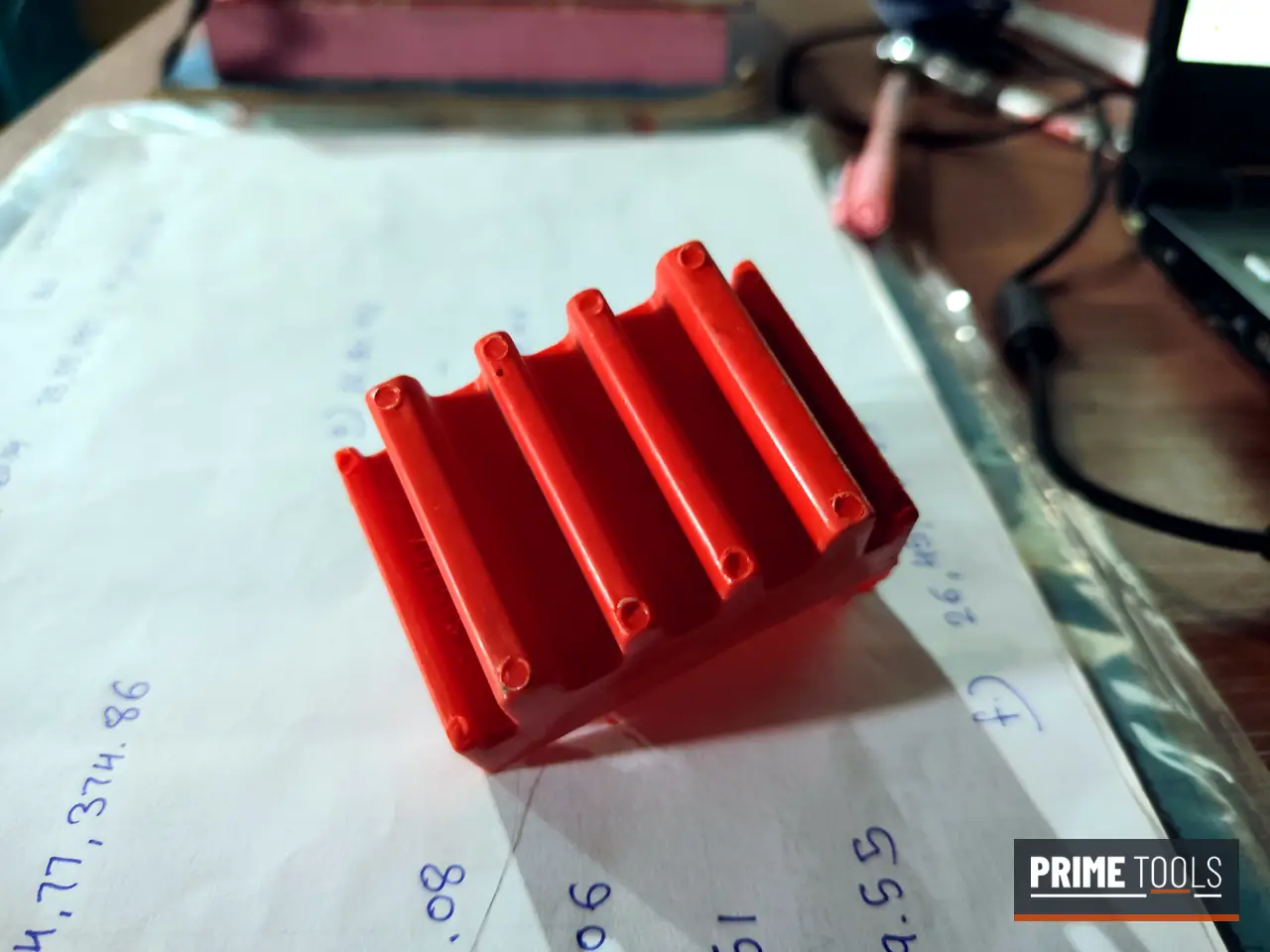
DMC is used wherever a part must be strong, heat resistant and electrically safe at a sensible cost. Common applications include:
- Switchgear and circuit protection: MCB and MCCB housings, arc chutes, contact carriers, busbar supports. See our switchgear parts page.
- Wiring devices: switch and socket bases, terminal blocks, fuse carriers. See wiring devices.
- Lighting: lamp holders, reflectors and street-light housings that must handle heat. See lighting.
- Motors and appliances: motor end shields, brush holders, iron and heater parts, and commutator insulation.
- Automotive: headlamp reflectors, under-bonnet parts and electrical connectors.
- Meters and energy: meter bases, terminal covers and insulators.
How DMC is moulded
DMC can be compression moulded, transfer moulded or injection moulded. Compression moulding is the most common route for medium-size parts and for parts where fibre length and strength matter. Here is what happens to a DMC part in a compression mould.
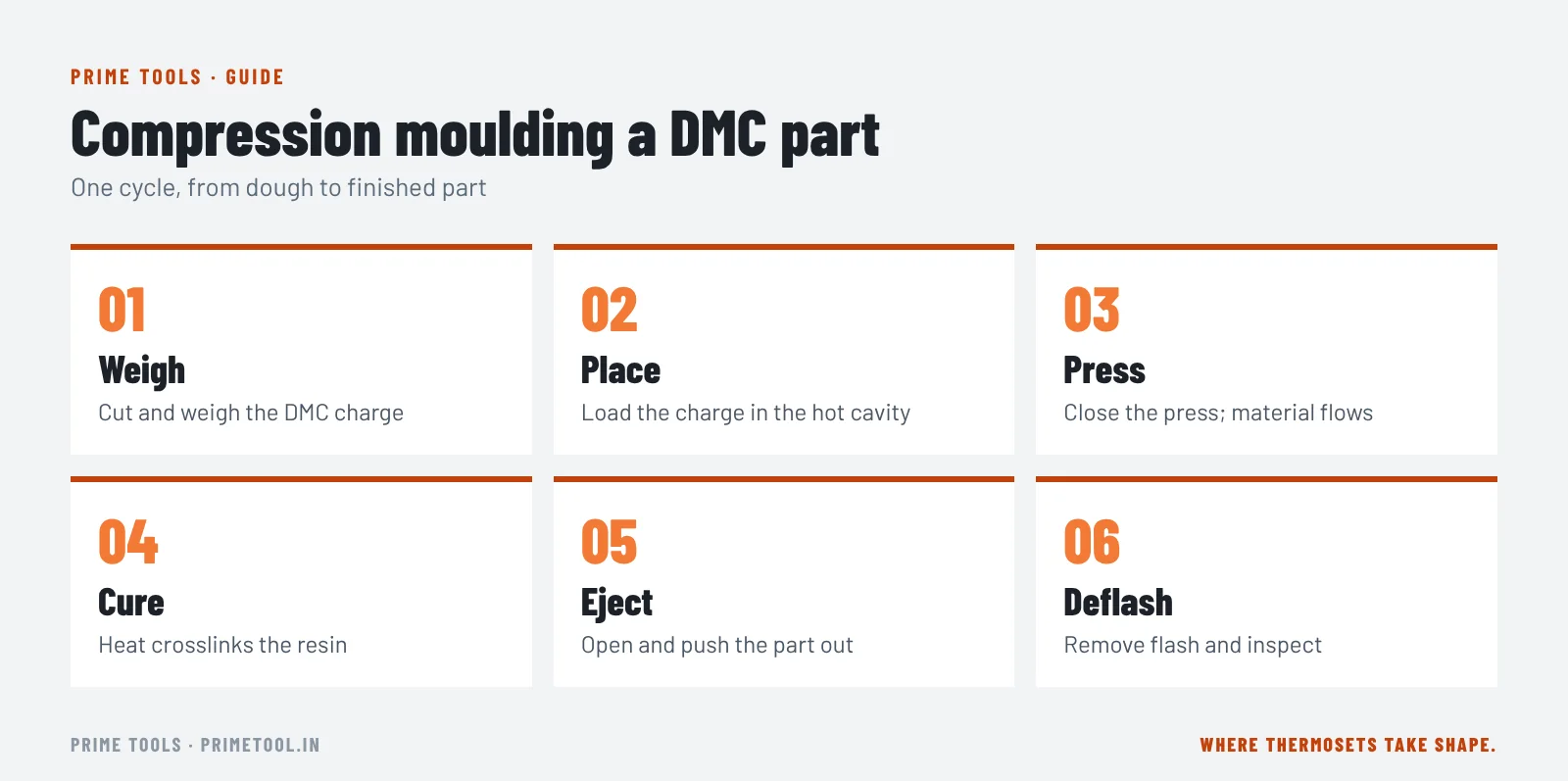
- Weigh the charge. The dough is cut and weighed. A consistent charge weight is the single biggest factor in consistent parts and low flash.
- Place the charge. The operator places the charge in the heated cavity, in the position agreed during mould design.
- Close and press. The press closes. The material flows, fills the cavity and the shear edges trap it.
- Cure. Heat from the mould starts the catalyst. The resin crosslinks and hardens. Cure time depends on wall thickness and the grade.
- Open and eject. The mould opens and ejector pins push the hot, rigid part out.
- Deflash and inspect. Thin flash along the parting line is removed, and the part is checked.
Typical mould temperatures for polyester DMC are in the region of 140 to 170 °C, but always follow the material supplier’s datasheet for the grade you are running. Moulding pressure depends on the part’s projected area and the grade’s flow. That is why we ask for the part model and the press details before we design a mould. You can see how we approach this on our DFM and mould design page.
What DMC means for the mould
This is where the toolmaker’s view matters. DMC is kind to part designers but hard on steel.
It is abrasive. Glass fibre and mineral fillers scour the cavity surface, the shear edges and the gate areas with every shot. A mould for DMC needs hardened tool steel and, in high-volume tools, hard chrome or other surface protection on the moulding faces.
Shear edges must be tight and stay tight. In a compression mould, the shear edge is where the two halves meet and cut off the excess material. As it wears, flash gets thicker, deflashing costs go up and parts start to vary. A good DMC mould is designed so the shear edge can be reworked or replaced.
Heating must be even. Uneven temperature across the mould gives uneven cure, which shows up as blisters, warpage or soft areas. We place cartridge heaters and thermocouples so the cavity and core stay within a narrow band.
Venting and ejection matter. Trapped air and volatiles cause burns and voids. Ejector pins must be placed where they will not mark visible faces but still push the part out cleanly.
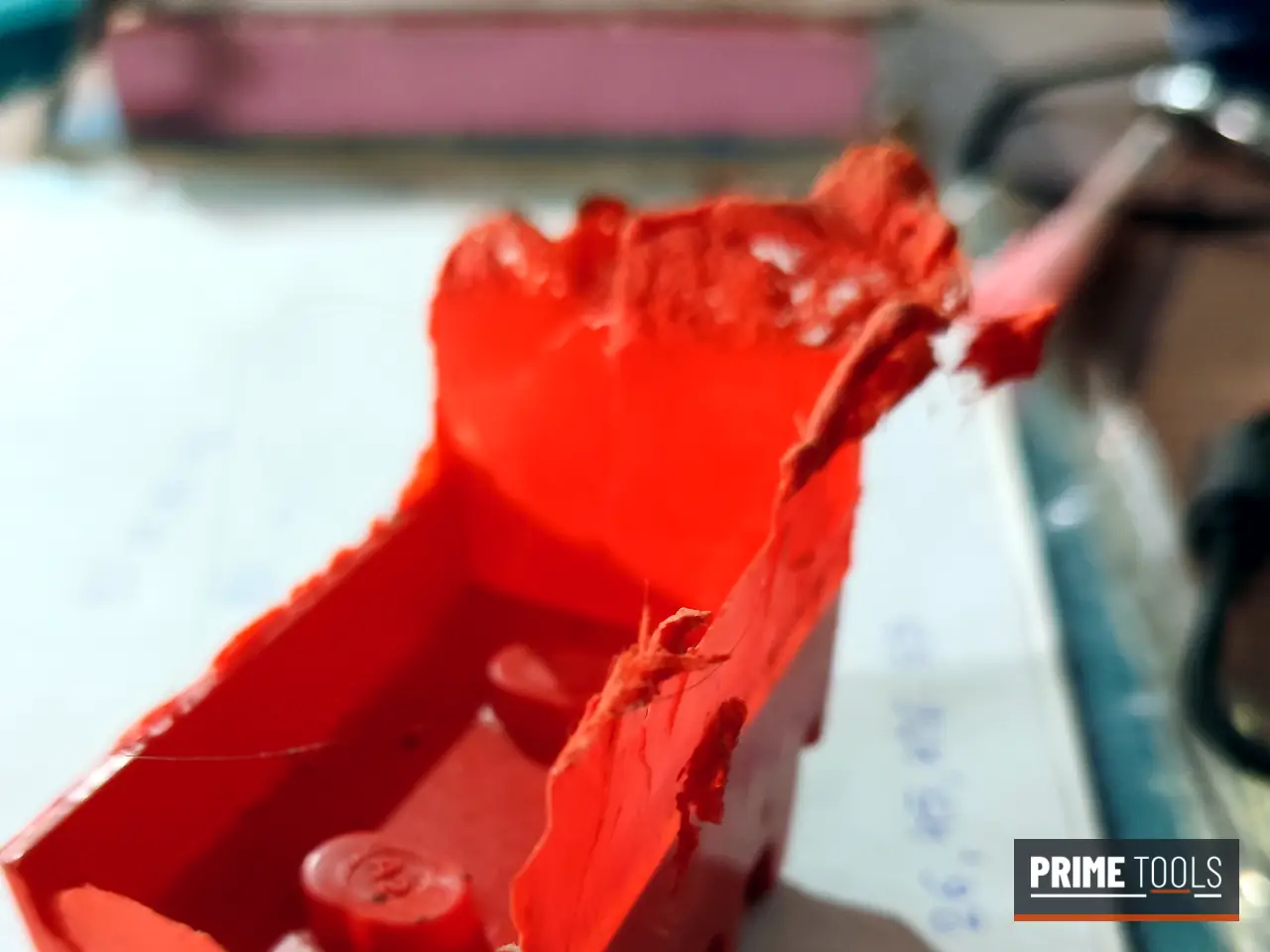
When those details are right, a DMC compression mould will run for years with periodic maintenance. When they are wrong, the mould will make flash, sticking and rejects from the first trial. Our mould repair service exists mostly because of worn shear edges and tired heating on older DMC and SMC tools.
Designing a part for DMC
If you are designing a new part in DMC, a few habits make moulding easier and the mould cheaper:
- Keep walls even. Thick sections take longer to cure and can blister. Thin sections may not fill. Aim for a uniform wall and core out heavy sections.
- Add draft. Give vertical faces draft so the cured part releases. Textured faces need more draft than polished ones.
- Use generous radii. Sharp internal corners stop flow and create stress points. Radii help the material flow and make the part stronger.
- Think about ribs. Ribs add stiffness without extra wall thickness, but very deep, thin ribs are hard to fill and hard to eject.
- Plan inserts early. Metal inserts can be moulded in, but they need locating pins and a clear place in the cycle.
- Mark the cosmetic faces. Tell the toolmaker which faces are visible so the parting line and ejector pins go elsewhere.
Our free compression moulding design guide covers these rules in more detail with checklists.
DMC vs SMC vs thermoplastic
DMC is not the only choice. Here is how it compares with its closest alternatives:
| DMC / BMC | SMC | Engineering thermoplastic (e.g. PA, PBT) | |
|---|---|---|---|
| Form | Dough / bulk premix | Sheet | Pellets |
| Fibre length | Short | Long (around 25 mm) | Short or none |
| Best for | Small to medium detailed parts | Large, flat or shell parts (enclosures, covers) | High-volume small parts, snap fits |
| Heat resistance | Very high (does not melt) | Very high (does not melt) | Limited by melting point |
| Strength | Good | Higher (longer fibre) | Varies, often tougher |
| Mould cost | Moderate | Higher (larger tools) | Higher (injection tools) |
For a closer look at the two thermoset compounds, read our guide to SMC vs BMC with real product examples. For the wider material question, see thermoset vs thermoplastic.
Free DFM review
Planning a mould for this part?
Send your 3D model or drawing, material and annual volume. Our engineers reply within one working day.
Choosing a toolmaker for DMC parts
A DMC part is only as good as the mould that shapes it. When you compare toolmakers, ask:
- Do they review your part for moulding (DFM) before quoting a final design?
- Which steel and hardness do they use for the cavity, core and shear edges?
- How do they plan heating and temperature control?
- Can they trial the mould and show you first-off parts before dispatch?
- Can they repair and maintain the mould later, including shear edge rework?
At Prime Tools in MIDC Ahilyanagar, Maharashtra, we design and build compression moulds for DMC, BMC, SMC, Bakelite, melamine and urea parts, with in-house VMC machining, EDM and grinding. Every new part gets a free DFM review. Send us your part and we will tell you honestly how it will mould.
Frequently asked questions
What is dough moulding compound used for?
DMC is used for electrical and heat-resistant parts: switchgear housings, terminal blocks, lamp holders, motor end shields, meter parts, insulators and some automotive components.
Is DMC the same as BMC?
In practice, yes. Both are short-glass-fibre polyester premixes that are moulded under heat and pressure. DMC is the traditional UK and Indian name; BMC is common in the US and in supplier catalogues.
Can DMC be injection moulded?
Yes. DMC and BMC can be compression, transfer or injection moulded. Compression moulding keeps fibres longer and is common for medium-size parts; injection suits high-volume small parts with special thermoset injection machines.
What temperature is DMC moulded at?
Polyester DMC is usually moulded with the mould around 140 to 170 °C. The exact temperature, pressure and cure time come from the material supplier’s datasheet for your grade and wall thickness.
Why does a DMC mould wear out?
The glass fibre and mineral fillers are abrasive. Over many shots they wear the cavity surface and the shear edges, which increases flash. Hardened steel, surface treatment and regular maintenance extend mould life.
Can DMC parts be recycled?
Cured DMC cannot be remelted. Scrap can be ground and used as filler in some applications, but it is not recycled like a thermoplastic.

Written by the Prime Tools engineering team
Compression mould makers in MIDC Ahilyanagar, Maharashtra, since 2015. We design and build moulds for SMC, DMC/BMC, Bakelite, melamine and urea parts, and repair die casting dies. About us
Keep reading
Die casting
Die Casting vs Sand Casting vs Investment Casting: Which Process Fits Your Part?
Die casting, sand casting and investment casting compared on cost, tooling, volume, tolerances, finish, metals and part size.
5 min read · Read article →
Design
3D Software for Mould Design: What Toolmakers Actually Use
The 3D CAD, CAM and simulation software toolmakers use for mould design: NX, SolidWorks, Creo, CATIA, Fusion, Mastercam, flow simulation and what files to…
5 min read · Read article →
Processes
How the Sheet Moulding Compound (SMC) Process Works, Step by Step
The sheet moulding compound (SMC) process from paste mixing and sheet making to maturation, charge cutting, moulding and finishing, with tooling tips.
6 min read · Read article →