
GRP Electrical Enclosures: Why Utilities Choose SMC, and How They Are Made
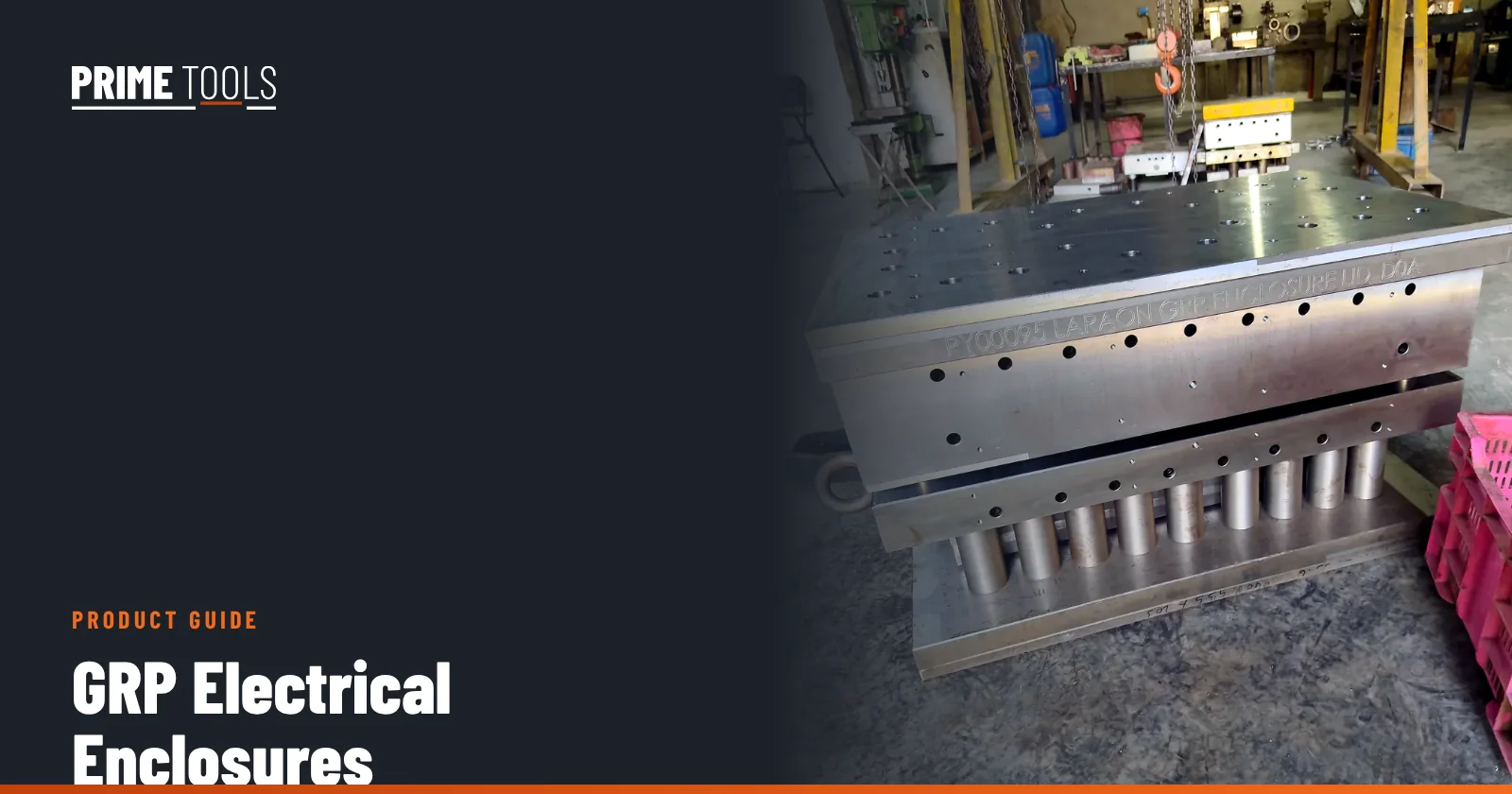
A GRP electrical enclosure is a box, cabinet or kiosk made from glass-reinforced plastic, the material also called fibreglass or FRP. Most high-volume GRP enclosures are compression moulded from SMC (sheet moulding compound). They are chosen by utilities, telecom operators, rail and industry because they do not rust, insulate electrically, resist UV and weather, are lighter than steel, and keep their strength for decades outdoors.
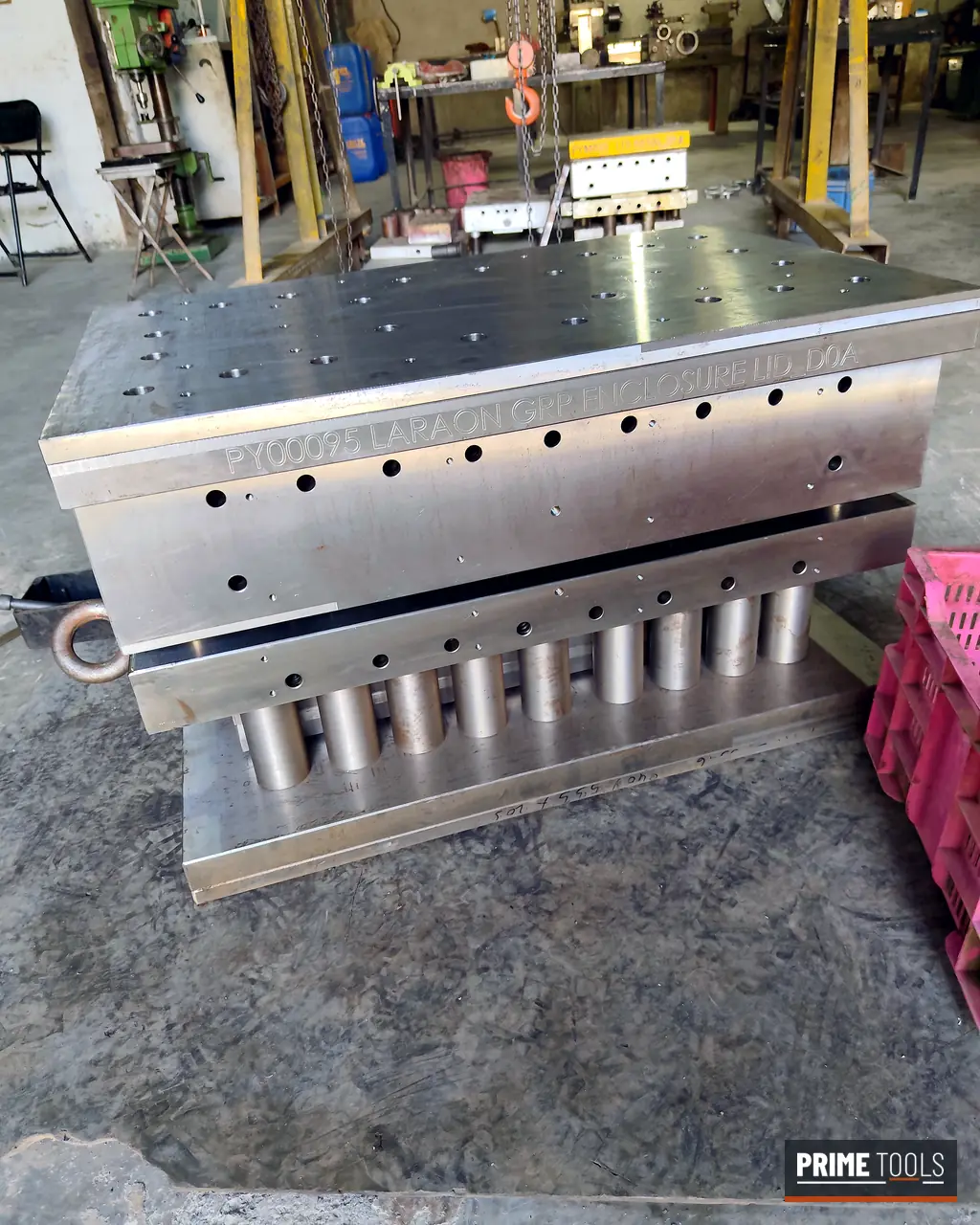
GRP enclosures are a big part of our work at Prime Tools. We design and build the compression moulds that enclosure manufacturers use to produce bases, lids, doors and frames, and we supply these tools in India and for export. This guide covers what buyers and specifiers ask most: material, ratings, types, and how a quality GRP enclosure is made.
What is GRP, and how does it relate to SMC and FRP?
GRP (glass-reinforced plastic), FRP (fibre-reinforced plastic) and fibreglass describe the same idea: a plastic resin, usually polyester, reinforced with glass fibre. The terms are regional: “GRP” is common in the UK and Middle East, “fiberglass” in the US, “FRP” in India.
SMC is a specific form of GRP: a ready-to-mould sheet of resin, filler and chopped glass fibre that is compression moulded in a heated steel mould. Most mass-produced GRP enclosures, meter boxes and kiosks are SMC. Low-volume or very large enclosures are sometimes made by hand lay-up or spray-up in open moulds, but these have only one finished face and more variation. Read more in SMC vs BMC.
Why choose GRP electrical enclosures over steel or plastic?
| GRP / SMC | Painted mild steel | Stainless steel | Thermoplastic (ABS / PC) | |
|---|---|---|---|---|
| Corrosion | Does not rust | Rusts when paint is damaged | Good, costly | Does not rust |
| Electrical | Insulating (no earthing of the body) | Conductive, must be earthed | Conductive | Insulating |
| UV / outdoor life | Very good with UV-stable grade | Depends on paint | Very good | Can yellow / embrittle |
| Heat and fire | Does not melt, flame-retardant grades | Does not burn | Does not burn | Can soften / melt |
| Weight | Light | Heavy | Heavy | Lightest |
| Rigidity in large sizes | High | High | High | Lower |
| Maintenance | Very low | Repainting | Low | Low |
| Theft value | None | Some | High | None |
That is why GRP is standard for outdoor feeder pillars, distribution kiosks, meter cabinets, telecom street cabinets, rail trackside boxes, EV charging pedestals and solar combiner boxes.
Types of GRP enclosures
- Wall-mounted enclosures: junction boxes, isolator boxes and small distribution boards. See SMC junction boxes and meter boxes.
- Floor-standing GRP enclosures and cabinets: larger cabinets on plinths or bases, for control gear and distribution.
- GRP kiosks and housings: walk-around or walk-in kiosks for substations, pumps, gas metering and telecom.
- Meter cabinets: for gas, water and electricity meters, often with viewing windows.
- Feeder pillars: low-voltage distribution on streets and estates.
- Modular enclosures: standard panels and doors that bolt together into many sizes.
Ratings to specify
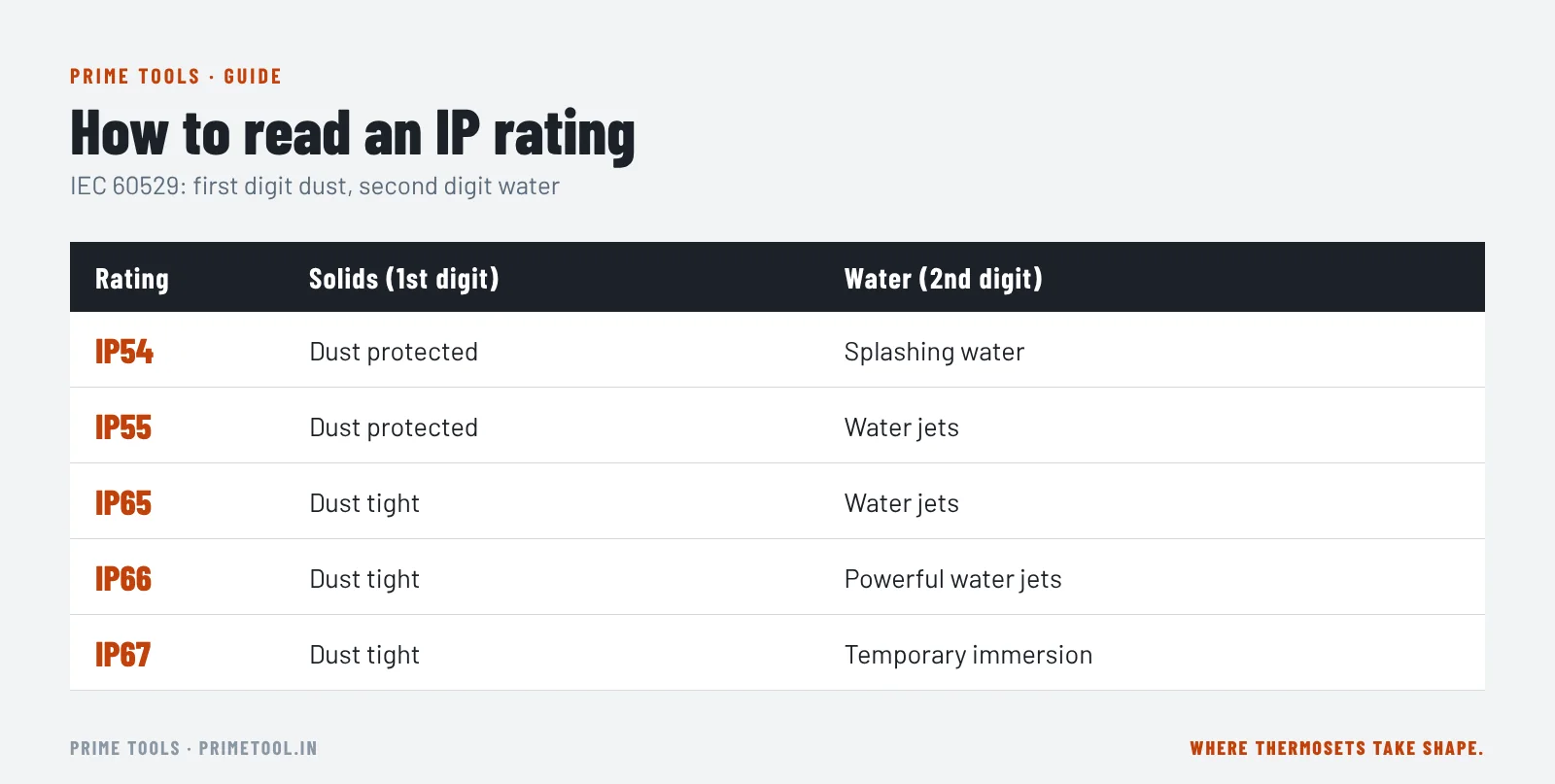
IP rating (IEC 60529): protection against solids and water. For outdoor enclosures, IP54 to IP66 is common. The first digit is dust protection (6 = dust tight) and the second is water (5 = water jets, 6 = powerful jets).
IK rating (IEC 62262): impact resistance, from IK00 to IK10. Outdoor GRP enclosures are often IK08 to IK10.
Flame rating: many electrical specifications call for UL 94 V-0 or glow-wire tests (IEC 60695-2-11) on enclosure materials.
UV stability: outdoor enclosures need UV-stabilised resin and pigment so colour and surface hold for years.
Insulation class: GRP enclosures can provide double (Class II) insulation, so the enclosure itself does not need earthing.
How a moulded SMC enclosure is made
- DFM study: wall thickness, ribs, draft, door and hinge features, gasket groove and mounting bosses are reviewed for moulding.
- Mould design: cavity and core, shear edges, heating, ejection and inserts (logos, threaded inserts) are designed in 3D.
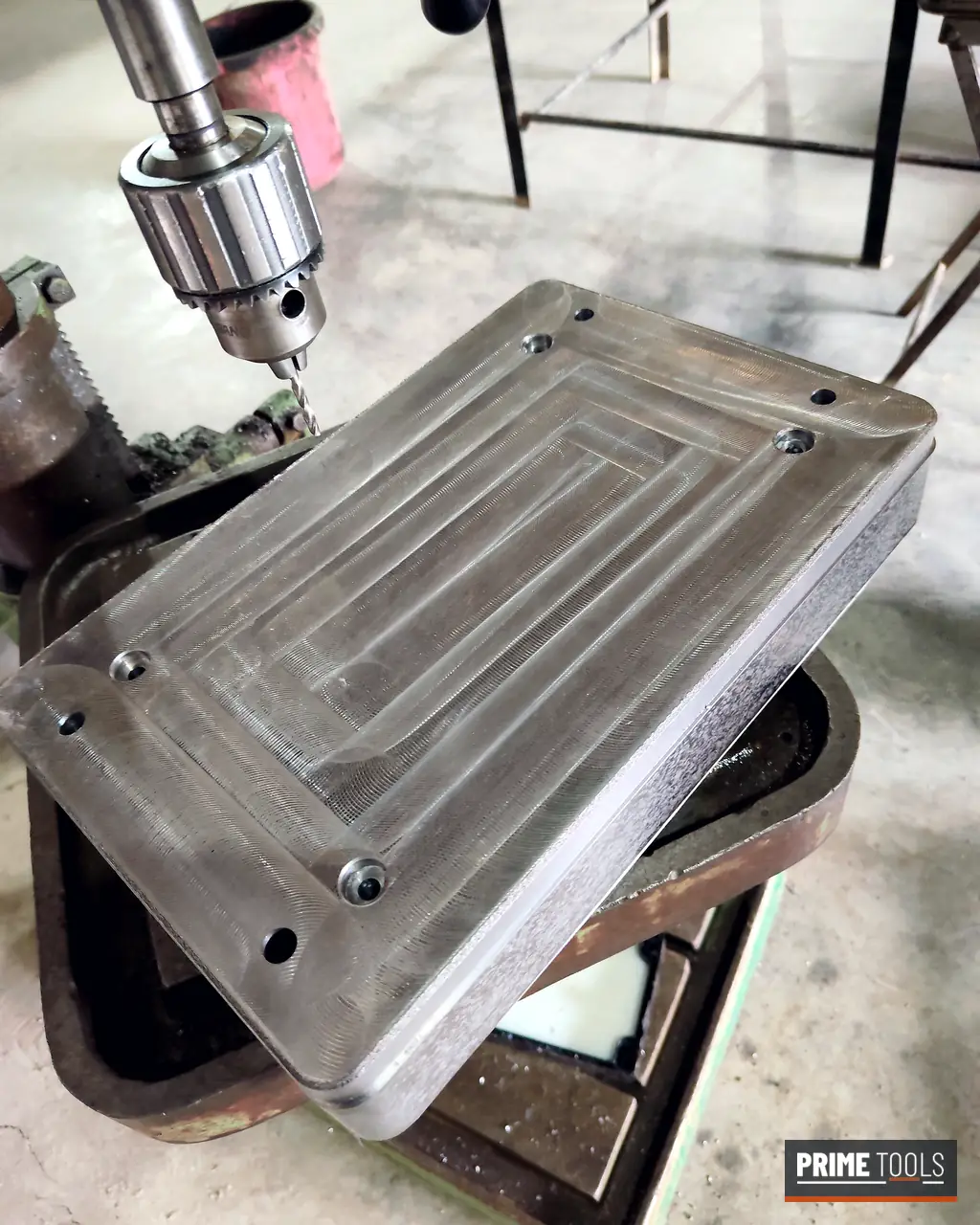
- Mould manufacture: steel is machined on VMC, detail burnt by EDM, then fitted, polished and assembled.
- Trial: the mould is tried on a press; first-off parts are checked.
- Production: SMC charges are pressed and cured, then parts are deflashed, drilled and assembled with gaskets, hinges and locks.
Our DFM and mould design page shows complete studies of SMC enclosure bases and lids.
Design features that make a better GRP enclosure
- Gasket grooves moulded in for consistent IP sealing.
- Ribs and box sections for stiffness without heavy walls.
- Moulded-in brass inserts for mounting plates and hinges.
- Rain canopies and drip edges on doors and lids.
- Textured outer surfaces that hide scratches and wear.
- Draft and radius for clean release and strength.
The UK, Middle East and export markets
GRP enclosures are a large market in the UK (where “GRP enclosure”, “GRP kiosk” and “GRP cabinet” are common searches), the UAE and the wider Middle East, as well as Europe and the US. Enclosure makers in these markets often source moulds from India for cost and lead time. Our export page explains how we ship moulds abroad, with trial reports, rust protection and documentation.
Moulded SMC vs hand lay-up GRP enclosures
Not all GRP enclosures are made the same way. Hand lay-up and spray-up build the enclosure in an open mould by laying glass mat and resin by hand. Tooling is cheap, which suits very large or one-off kiosks, but only one face is finished, wall thickness varies, and every part depends on the laminator’s skill.
SMC compression moulding presses the material between two hardened steel halves. Both faces are finished, wall thickness and weight are consistent, features such as gasket grooves, bosses and ribs are moulded in, and cycle times are minutes rather than hours. The tooling investment is higher, so SMC wins whenever volumes are steady: standard enclosure ranges, meter cabinets, feeder pillar parts and kiosk panels.
Many manufacturers combine both: moulded SMC doors, lids and panels assembled onto a frame, giving standard parts at low cost while still offering many sizes.
Maintenance and long-term performance
GRP enclosures need little care: occasional cleaning, checking gaskets and hinges, and replacing locks if damaged. Unlike steel, there is no repainting and no rust to treat. Faded surfaces on very old enclosures can be restored with a UV-resistant coating. For the moulds that make them, plan regular shear edge and surface maintenance, as described on our mould repair page.
Free DFM review
Planning a mould for this part?
Send your 3D model or drawing, material and annual volume. Our engineers reply within one working day.
Frequently asked questions
What is a GRP enclosure?
An enclosure made from glass-reinforced plastic. It is corrosion-free, insulating and weather resistant, and widely used outdoors for electrical, telecom and utility equipment.
Is GRP the same as fibreglass?
Yes. GRP, FRP and fibreglass all describe glass-fibre-reinforced plastic. SMC is a moulded form of it.
What IP rating do GRP enclosures have?
It depends on design and gasket. Outdoor GRP enclosures are typically IP54 to IP66.
Do GRP enclosures need earthing?
The GRP body is non-conductive and can provide double insulation, so the body itself does not usually need earthing. Follow your electrical code for the equipment inside.
How long do GRP enclosures last outdoors?
With UV-stabilised material, GRP enclosures commonly last decades outdoors with very little maintenance.
Can you make moulds for GRP enclosures?
Yes. Prime Tools designs and builds SMC compression moulds for enclosure bases, lids, doors and frames, for Indian and export customers.
Related reading: battery boxes for inverters, and why SMC is used and FRP vs GI vs SS cable trays.

Written by the Prime Tools engineering team
Compression mould makers in MIDC Ahilyanagar, Maharashtra, since 2015. We design and build moulds for SMC, DMC/BMC, Bakelite, melamine and urea parts, and repair die casting dies. About us
Keep reading
Products
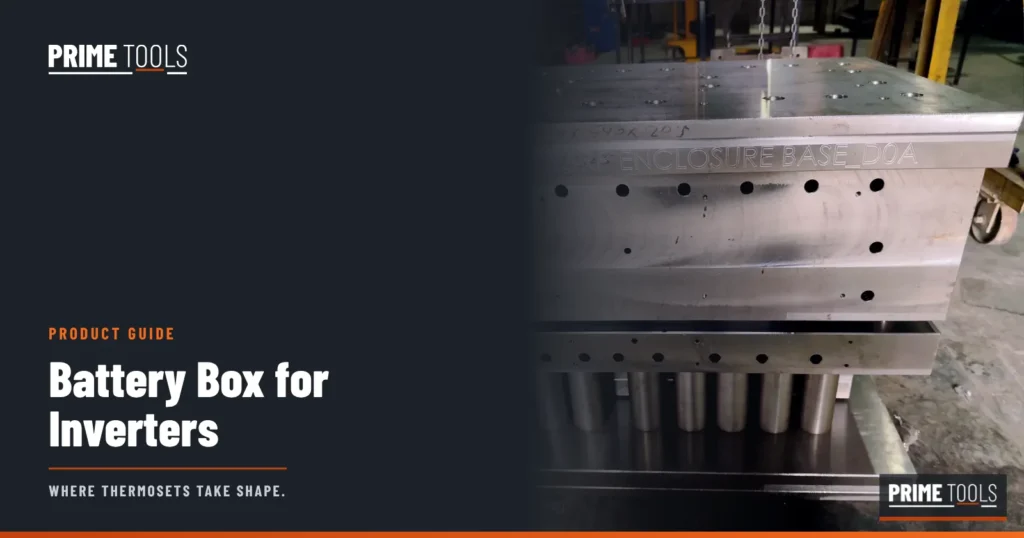
Battery Box for Inverters: Why SMC and BMC Are Used, and What to Look For
Inverter battery boxes compared: SMC/BMC, plastic and metal. Heat, acid and fire resistance, ventilation, and how SMC battery boxes are moulded.
5 min read · Read article →
Products
FRP vs GI vs SS Cable Trays: Types, Comparison and How to Choose
Cable tray types (perforated, ladder, raceway) and materials (FRP/GRP, GI, SS, aluminium) compared on corrosion, strength, weight, cost and where each is used.
6 min read · Read article →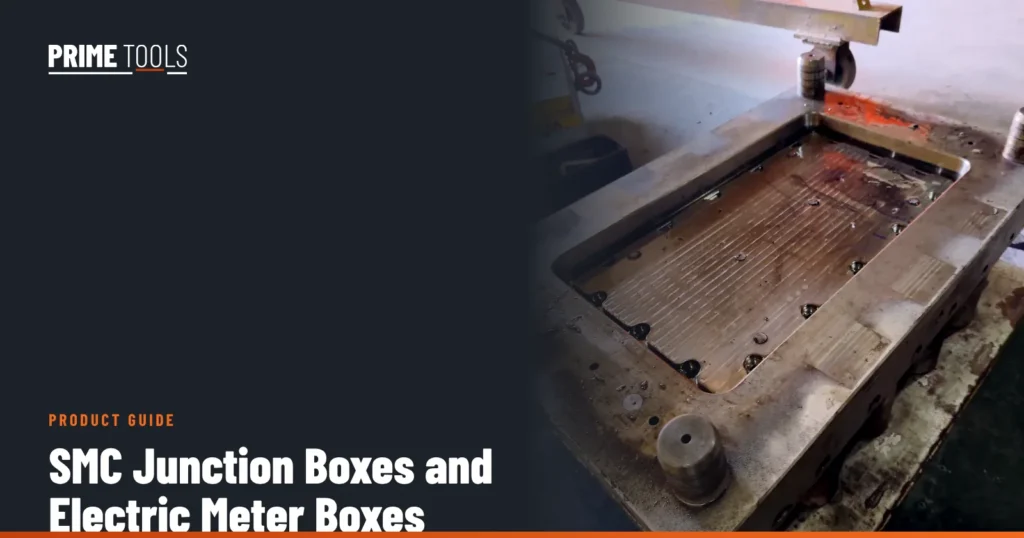
Products
SMC Junction Boxes and Electric Meter Boxes: Materials, IP Ratings and Mould Design
SMC junction box, FRP, ABS and metal junction boxes and meter boxes compared: IP ratings, single and three phase boxes, and SMC box moulds.
6 min read · Read article →