
How the Sheet Moulding Compound (SMC) Process Works, Step by Step
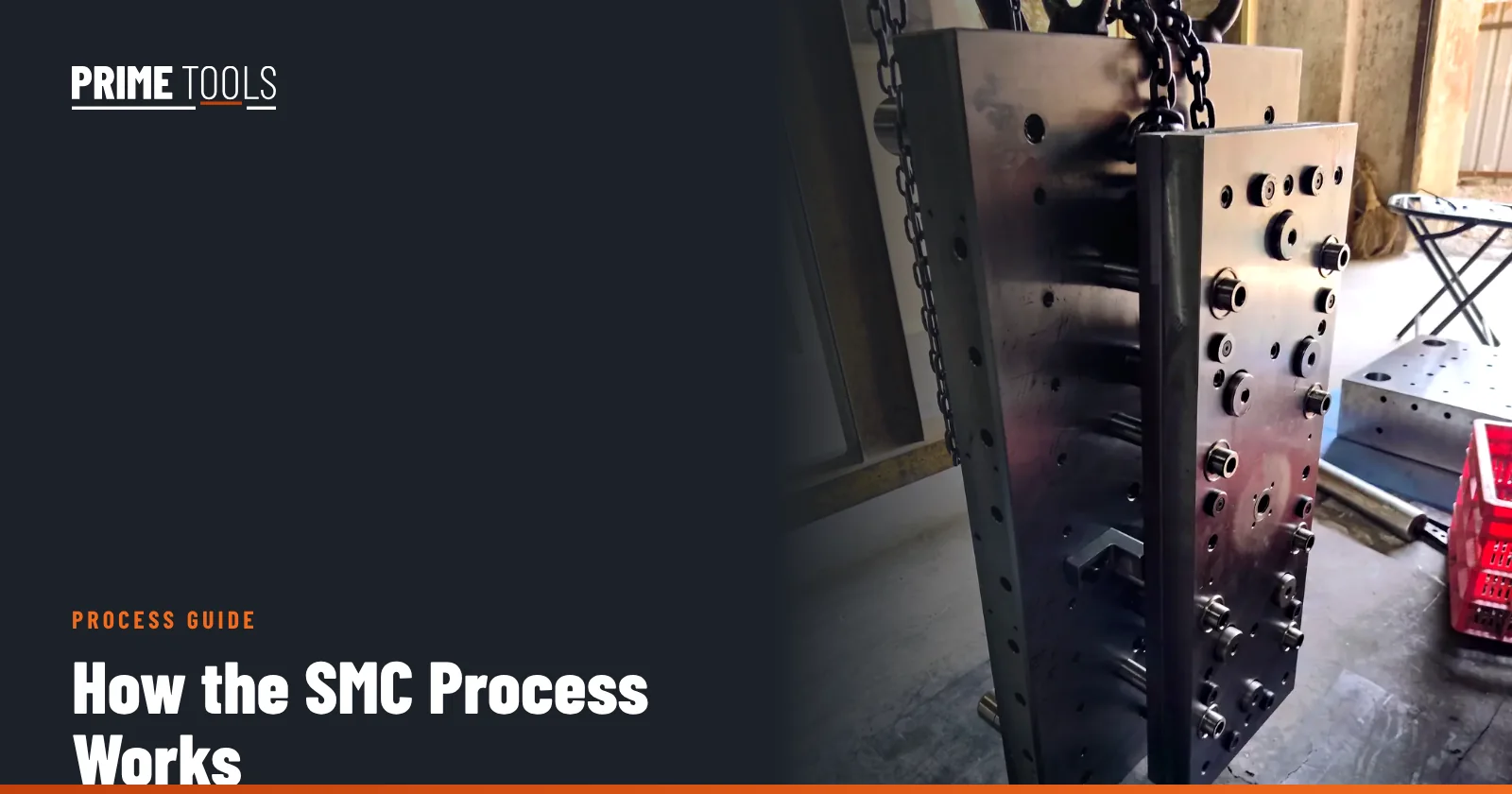
The sheet moulding compound (SMC) process has two halves. First, the compound is made: a resin paste and chopped glass fibre are combined between two films, compacted into a sheet and left to mature until it thickens. Second, the part is moulded: the sheet is cut into a charge, placed in a heated steel mould and pressed, so it flows, fills the cavity and cures into a strong, rigid part in a few minutes or less.
SMC is behind many of the electrical enclosures, meter boxes, manhole covers and automotive panels around you. At Prime Tools we build the compression moulds for SMC parts, and we trial every one before it leaves our tool room. This guide walks through each step and what it means for part quality.
Part 1: Making the sheet moulding compound
1. Mixing the paste
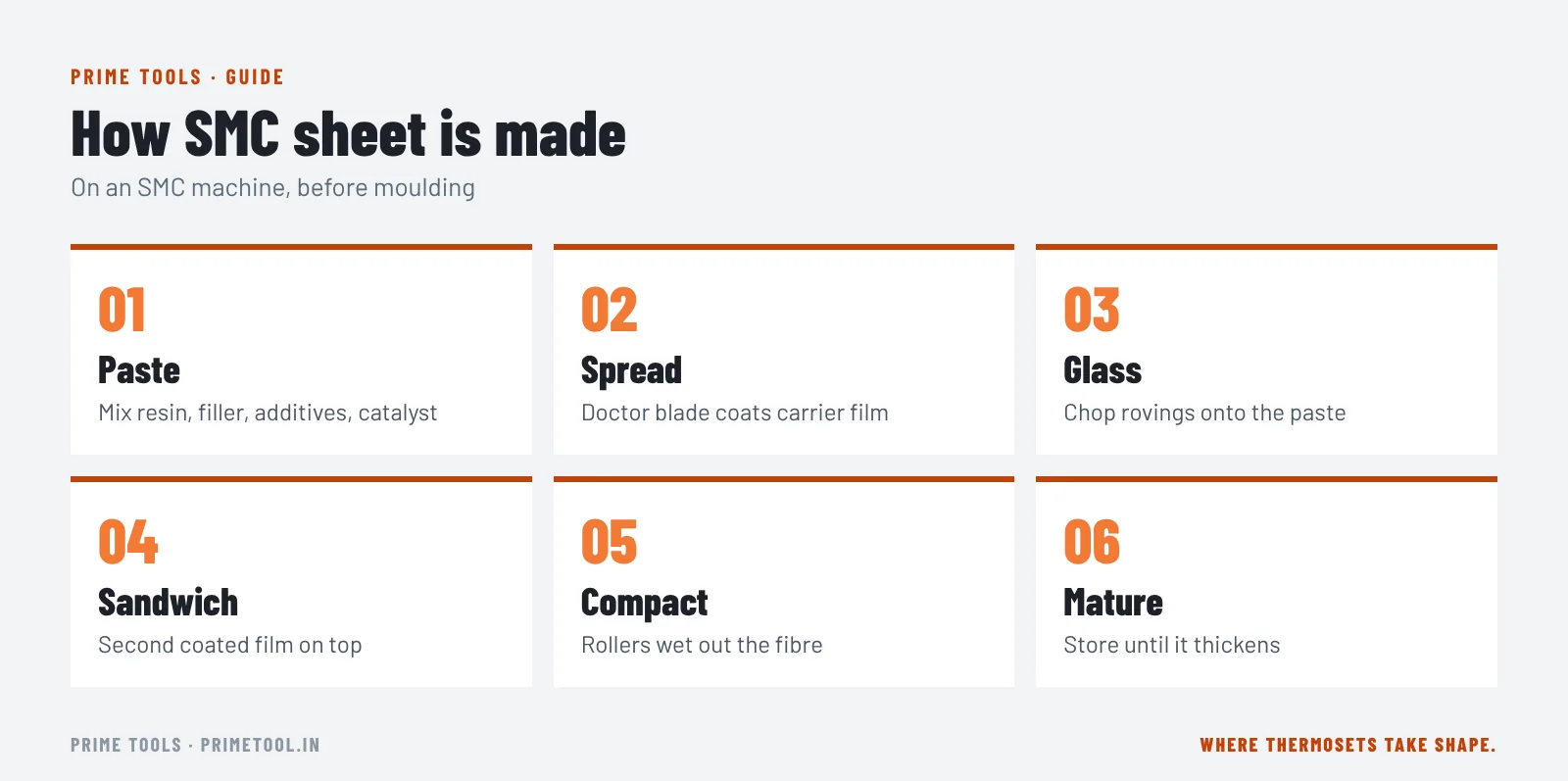
The paste is a blend of unsaturated polyester (or vinyl ester) resin, mineral filler (often calcium carbonate, or ATH for flame retardant grades), low-profile additive for shrinkage control, catalyst, internal release agent, pigment and a thickener (often magnesium oxide). The recipe sets the grade’s strength, flame rating, colour, flow and surface finish.
2. Spreading the paste on film
On the SMC machine, the paste is spread evenly onto a moving carrier film using a doctor blade. A second film is coated the same way.
3. Adding the glass fibre
Continuous glass rovings are chopped into short lengths, typically around 25 mm, and dropped evenly onto the paste layer. The fibre content and its even spread are critical to part strength.
4. Compaction
The second paste-coated film is laid on top, making a sandwich. Rollers knead and compact the sandwich so the fibres are fully wetted out by the resin and air is squeezed out.
5. Maturation
The sheet is rolled up or festooned into boxes and left to mature, often for a few days in controlled conditions. The thickener raises the viscosity, turning the sticky paste into a leather-like sheet that can be cut and handled, while still flowing under heat and pressure in the mould.
Part 2: Moulding the SMC part
6. Cutting and stacking the charge
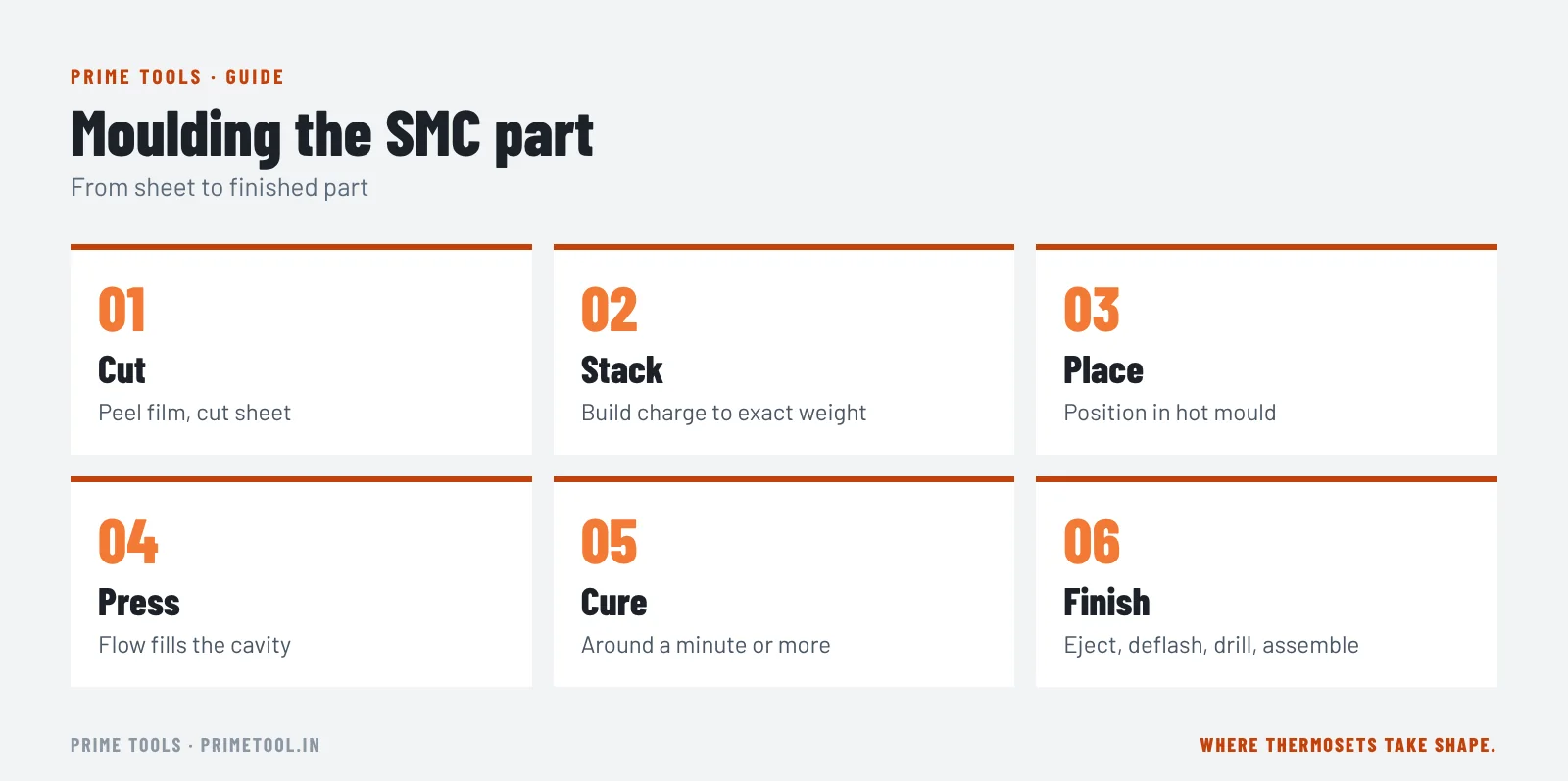
At the press, the films are peeled off and the sheet is cut into pieces. These are stacked into a charge. The charge typically covers only part of the mould area (often roughly 40 to 70 percent, depending on the part), so the material flows outwards and pushes air ahead of it.
7. Placing the charge
The charge is placed in the lower half of the heated mould, at the position agreed during mould design. Poor charge placement causes knit lines, non-fill and uneven fibre distribution.
8. Pressing and flow
The press closes, quickly at first and then slowly as the upper mould touches the charge. The material flows, fills the cavity and reaches the shear edge, where the tight clearance between the two halves stops it and allows only a thin flash.
9. Curing
The mould, usually around 140 to 160 °C for polyester grades (check the supplier datasheet), cures the resin while the press holds pressure. A thin-walled part can cure in around a minute; thick parts take longer.
10. Ejection, deflashing and finishing
The press opens, ejectors push the part out, and it is placed on a cooling fixture if it is large and flat. Flash is removed, holes may be drilled, inserts fitted and gaskets added. Some parts are painted, though many SMC parts are moulded in colour.
What the mould must get right
The SMC process only works as well as the mould. Here is what we focus on when we design and build SMC tools:
- Shear edge: the clearance and hardness of the shear edge around the whole part perimeter decide flash thickness. On large enclosures, this edge runs for metres.
- Even heating: cartridge heaters placed so the whole moulding face stays at an even temperature. Uneven heat means uneven cure and warpage.
- Stiffness: SMC needs high pressure over large areas, so plates and supports must not deflect.
- Venting: air and curing gases must escape, especially at the end of flow.
- Ejection: large thin parts need well-spread ejection so they come out flat.
- Surface finish: polish, and chrome plating for long runs or high-gloss faces.
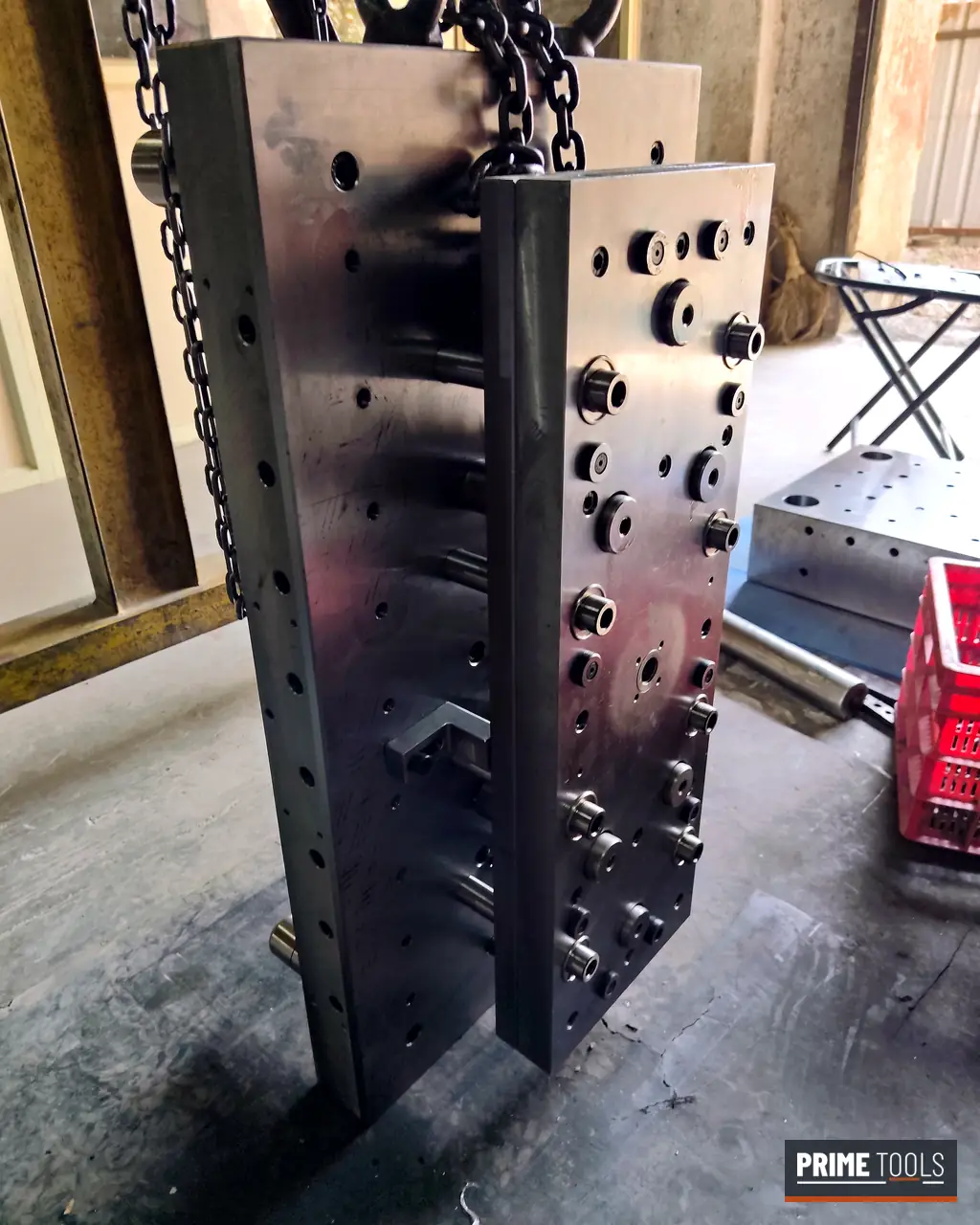
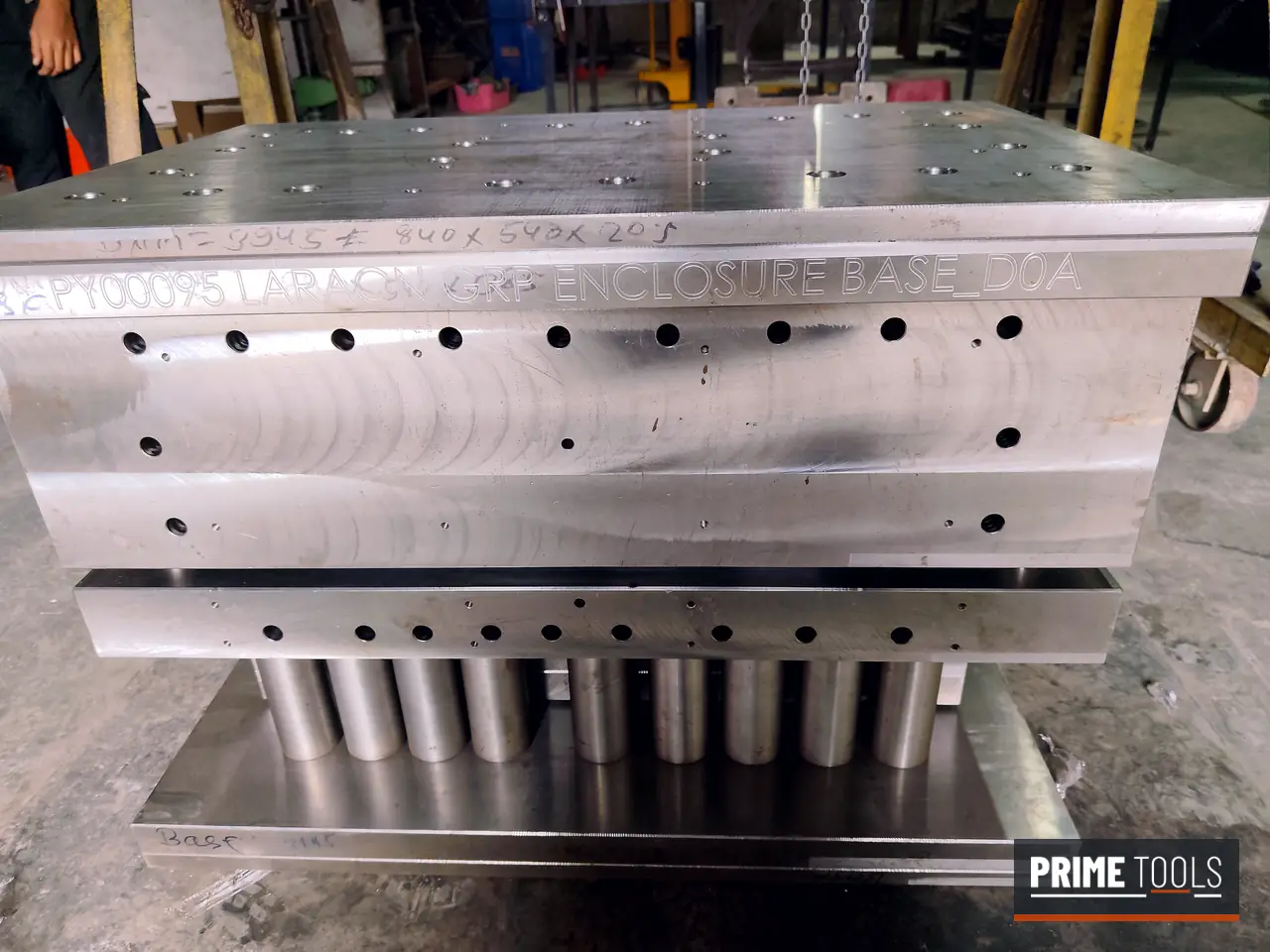
Our SMC moulds page shows more of our work, and the DFM and mould design page shows how we study charge placement and flow before cutting steel.
Typical SMC process problems and fixes
| Problem | Likely cause | First thing to check |
|---|---|---|
| Non-fill at far corners | Charge too small or badly placed, material too mature | Charge weight and placement; material age |
| Heavy flash | Shear edge wear, excess charge, low tonnage | Shear edge clearance |
| Blisters | Under-cure, trapped gas, moisture | Cure time, temperature, venting |
| Warpage | Uneven temperature, uneven wall, early ejection | Mould temperature map |
| Surface waviness / sink | Shrinkage, wall thickness changes | Low-profile additive, rib design |
| Fibre-rich or resin-rich areas | Flow too long, charge placement | Charge shape and position |
SMC process vs other composite processes
SMC is a closed-mould, high-pressure process. Compared with hand lay-up or spray-up (open mould, used for boats and tanks), SMC gives two finished faces, much more consistent parts and far faster cycles, but needs a steel mould and a press. Compared with resin transfer moulding (RTM), SMC is faster for medium and high volumes. That is why SMC dominates electrical enclosures and utility products.
If you are deciding between compounds, read SMC vs BMC. For the wider process view, read compression moulding explained.
Free DFM review
Planning a mould for this part?
Send your 3D model or drawing, material and annual volume. Our engineers reply within one working day.
Frequently asked questions
What is the SMC process?
It is the manufacture of sheet moulding compound (resin paste plus chopped glass between films, matured into a sheet) followed by compression moulding the sheet in a heated mould to make a part.
How long does SMC take to cure?
In the mould, many SMC parts cure in around one to a few minutes, depending on wall thickness, mould temperature and grade.
What is SMC maturation?
After the sheet is made, it is stored so the thickener raises its viscosity. Matured SMC is easy to handle and cut but still flows under heat and pressure.
What fibre length is used in SMC?
Typically around 25 mm (1 inch) chopped glass, which gives SMC its strength compared with short-fibre BMC.
What pressure is used for SMC moulding?
SMC is moulded at relatively high pressure over the part’s projected area. The press tonnage needed depends on part size, grade and design, which is checked during DFM.
Can SMC parts be painted?
Yes, though many are moulded in colour. Painting needs good surface finish and proper surface preparation.

Written by the Prime Tools engineering team
Compression mould makers in MIDC Ahilyanagar, Maharashtra, since 2015. We design and build moulds for SMC, DMC/BMC, Bakelite, melamine and urea parts, and repair die casting dies. About us
Keep reading

Processes
Choosing a Compression Moulding Press: Tonnage, Platen Size, Daylight and More
What to check when choosing a compression moulding press: tonnage, platen size, daylight, speed control, ejection and heating, and how it must match the…
5 min read · Read article →
Processes
Compression Moulding of Rubber vs Thermosets vs Composites and Carbon Fibre
How compression moulding differs for rubber, thermosets (SMC, DMC, Bakelite) and composites: materials, temperatures and mould design.
5 min read · Read article →
Processes
Compression Moulding Explained: Process, Advantages and Limitations
How compression moulding works step by step, the materials it uses, its advantages and disadvantages, and what makes a good compression mould.
6 min read · Read article →