
Compression Molding: Process, Materials, Molds and Costs
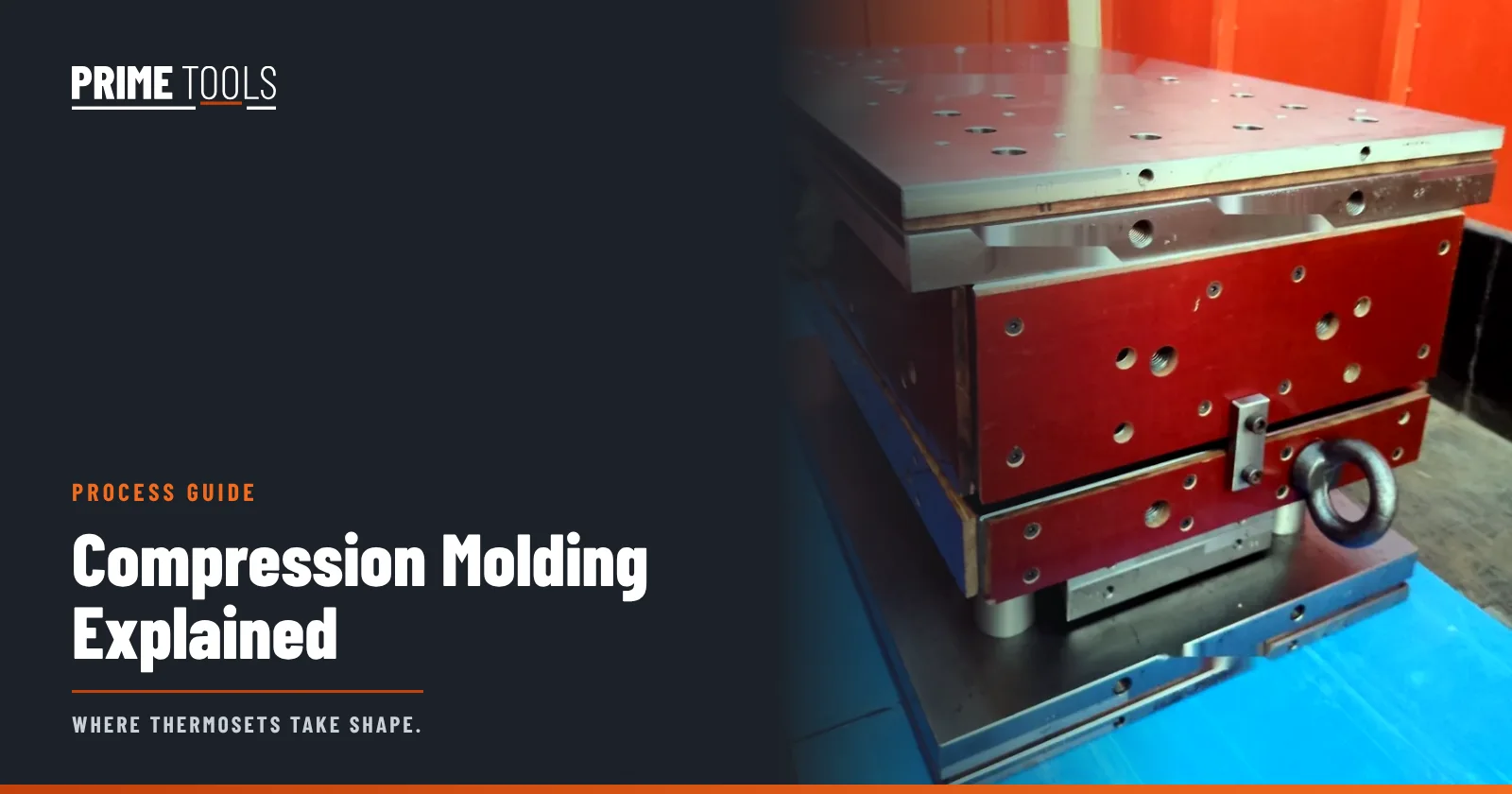
Compression molding is a manufacturing process in which a measured charge of material, usually a thermoset such as SMC, BMC or phenolic, is placed into an open, heated mold; a hydraulic press closes the mold, the heat and pressure make the material flow and fill the cavity, and it cures into a solid part that is then ejected. It is the standard way to make strong, heat-resistant and electrically insulating parts such as electrical enclosures, meter boxes, switchgear, automotive panels and covers.
Most guides to this process are written by people who buy molds or run presses. This one is written by people who build them, so it goes further into what makes the process work: the mold.
You will learn how it works, which raw materials it suits, the four types of mold, the design rules that matter, what drives cost, and when it beats injection molding.
What is compression molding?
In compression molding, the material is placed directly into the mold cavity rather than injected through runners. The mold is mounted in a vertical hydraulic press and held at a curing temperature, typically around 140-170 °C (285-340 °F) for SMC and BMC. When the press closes, the machine applies pressure that forces the softened material into every part of the cavity.
The material then cross-links (cures) and becomes permanently hard. Once it has cured, the press opens and ejector pins push the part out.
Because the material travels only a short distance, the process keeps long reinforcing fibers intact and wastes very little raw material. That is why compression molding produces molded parts that are stronger and more dimensionally stable than many injection-molded equivalents.
Compression molding machines
Molding requires a vertical hydraulic press with heated platens or a heated mold, accurate temperature control and a controlled closing speed. Press size is set by the projected part area multiplied by the molding pressure, so large SMC parts need presses of several hundred tonnes. Many compression molding machines also have programmable breathing (a short opening to release gas) and ejection. We trial every mold on presses up to 400 tonnes before shipping.
The compression molding process, step by step
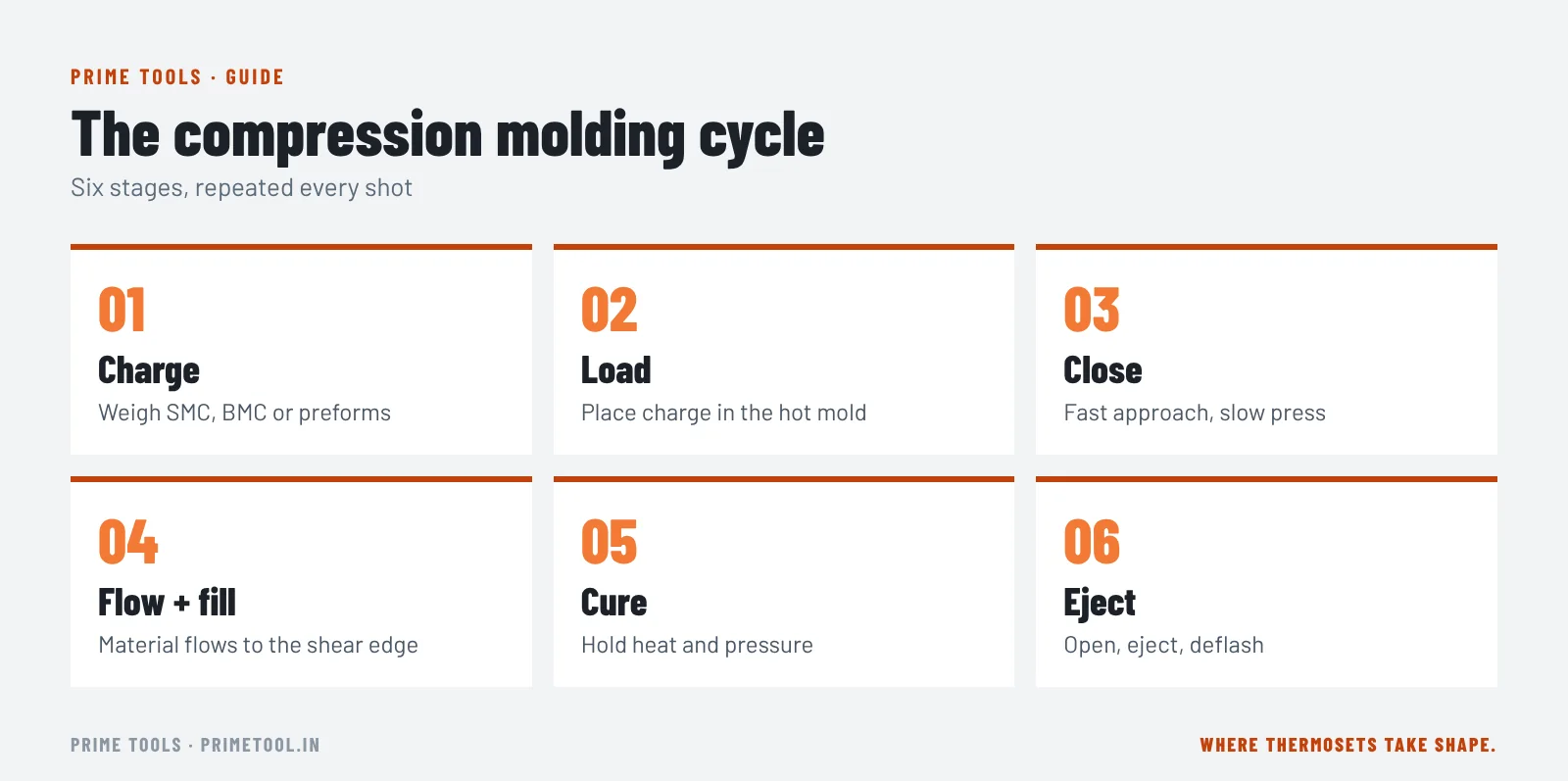
- Prepare the charge. The material is weighed and cut or pre-formed: sheets of SMC, logs of BMC, or pre-weighed powder or pellets. Some materials are pre-heated to shorten the cycle.
- Load the mold. The charge is placed in the open, heated mold, in a pattern that helps it flow evenly.
- Close the press. The press closes fast, then slows near the end to avoid trapping air.
- Flow and fill. Pressure, often in the range of about 1,000-2,000 psi on the part area for SMC, makes the material flow to the edges of the cavity. Excess material escapes at the shear edge as thin flash.
- Cure. The mold stays closed while the material cures. Cure time depends on material and wall thickness, from under a minute for thin parts to several minutes for thick ones.
- Eject and finish. The press opens, ejectors lift the part, and flash is removed by deflashing, trimming or tumbling.
For the full details on cycle settings, read our guide to the compression moulding process.
Materials used in compression molding
The process is used to produce parts from thermosets, rubber and composite materials:
| Material | What it is | Typical parts |
|---|---|---|
| SMC (sheet molding compound) | Glass-fiber reinforced polyester sheet | Enclosures, meter boxes, panels, covers |
| BMC / DMC (bulk or dough molding compound) | Glass-fiber reinforced polyester dough | Switchgear, appliance and lighting parts |
| Phenolic (Bakelite) | Heat-resistant thermoset powder | Handles, electrical parts, knobs |
| Melamine and urea | Hard, glossy thermosets | Dinnerware, wiring devices, caps |
| Epoxy and DAP | High-performance electrical thermosets | Connectors, insulators |
| Rubber and silicone | Vulcanized elastomers | Seals, gaskets, keypads |
| Composites (GMT, prepreg) | Long glass or carbon fibers | Structural and automotive parts |
Learn how the most common materials compare in SMC vs BMC and thermoset vs thermoplastic.
Types of compression mold
How the mold controls the material at the parting line decides part density, flash, material use and mold cost.
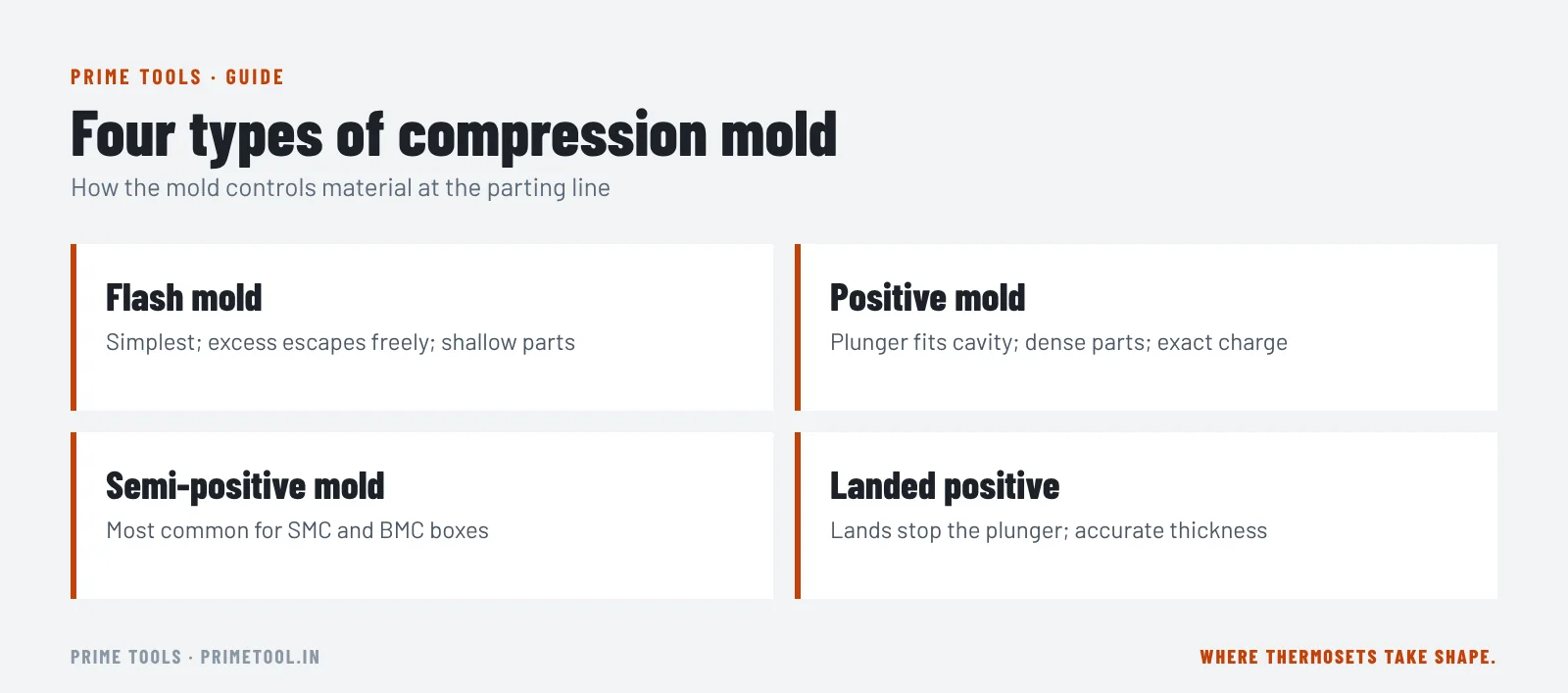
- Flash mold. The simplest and cheapest. Excess material escapes freely at the parting line. Good for shallow parts; less control over density and more flash.
- Positive mold. The plunger fits closely into the cavity, so almost no material escapes. Gives dense parts but needs an accurate charge weight and is harder to eject.
- Semi-positive mold. Combines the two: a flash-type start and a positive-type finish. The most common design for SMC and BMC parts such as enclosures and boxes.
- Landed positive mold. Like a positive mold, but with lands that stop the plunger at a set depth, giving accurate thickness. Used where part thickness must be tightly controlled.
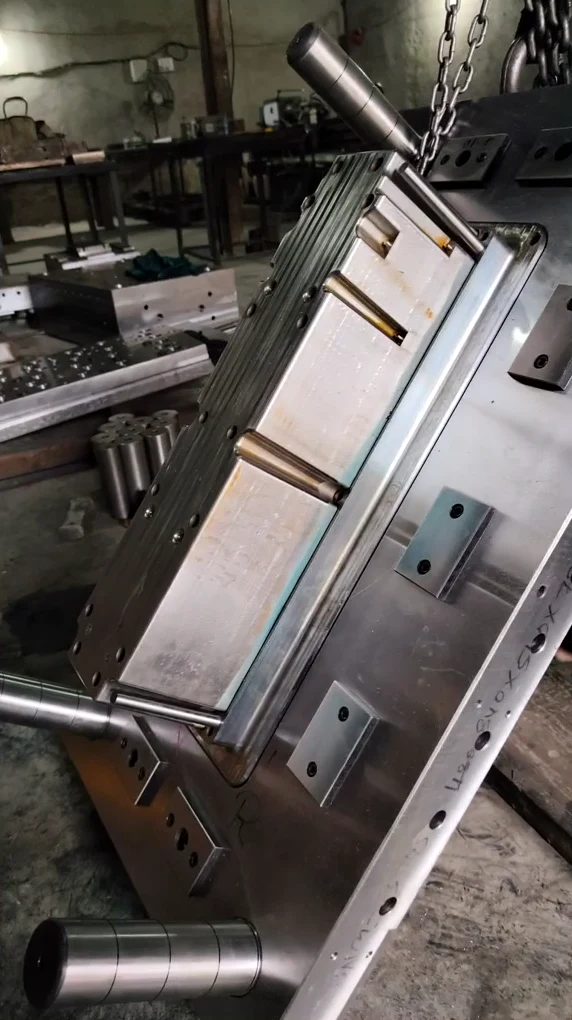
Most production molds for SMC use a hardened shear edge with a small, controlled clearance. That edge is the most important feature of the mold: it seals the cavity so pressure builds, and it cuts the flash cleanly. It must be hardened and maintained, because a worn shear edge means thick flash and poor parts.
Compression mold design rules
The part and mold design decide whether a compression-molded part is easy to make. Key rules:
- Uniform wall thickness: even walls cure evenly and warp less. Typical SMC walls are about 2-5 mm (0.08-0.2 in).
- Draft: allow at least 1-3° on vertical walls so parts release cleanly; more on textured surfaces.
- Ribs and bosses: keep ribs thinner than the wall they support, and core out thick bosses to avoid sink and long cures.
- Radii: avoid sharp internal corners; generous radii help flow and reduce stress.
- Undercuts: avoid them where possible; side cores add cost and complexity.
- Inserts: metal inserts can be molded in, but they must be located and held securely.
- Heating: the mold needs evenly spaced cartridge heaters or heating plates with zoned control, so the cavity and core stay within a few degrees.
A DFM review checks all of these before steel is cut. It is the cheapest point to fix a problem.
Free DFM review
Planning a mould for this part?
Send your 3D model or drawing, material and annual volume. Our engineers reply within one working day.
Compression molding vs injection molding
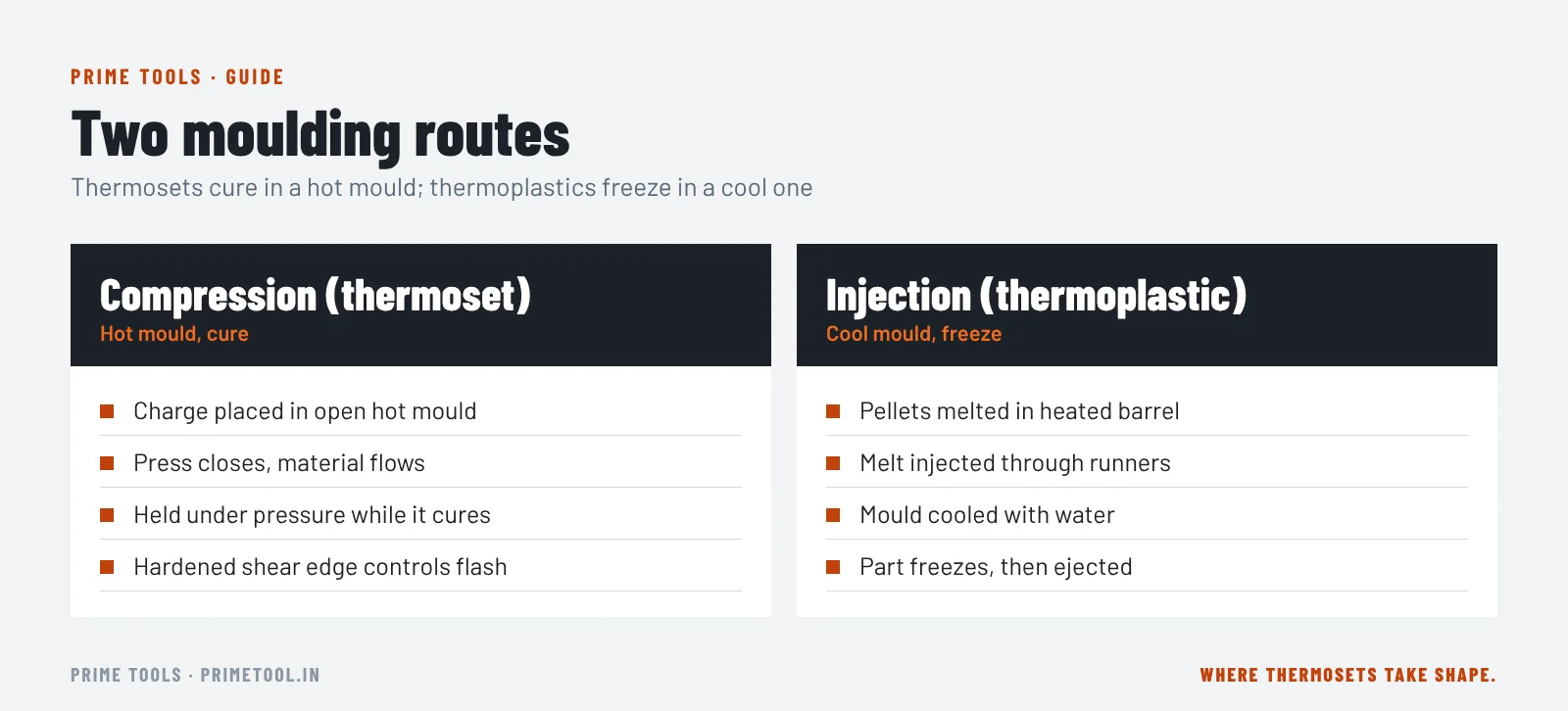
| Compression molding | Injection molding | |
|---|---|---|
| Typical materials | Thermosets, composites, rubber | Thermoplastics |
| Mold | Heated, simpler, no runners | Cooled, runners and gates |
| Tooling cost | Lower for large parts | Higher, especially multi-cavity |
| Cycle time | Longer (cure time) | Shorter |
| Part size | Excellent for large, thick parts | Best for small and medium parts |
| Fiber strength | Long fibers kept intact | Fibers shortened by the screw |
| Material waste | Very low | Runners and sprues |
| Finishing | Flash removal needed | Gate trimming |
Choose it for large, strong, heat-resistant or electrically insulating parts in medium volumes. Choose injection molding for small, intricate thermoplastic parts in very high volumes.
Advantages of compression molding
Advantages:
– Large, strong parts in one piece, with high quality surfaces on both sides.
– Cost effective tooling: lower than injection molding for big parts.
– Very little raw material waste.
– High performance heat, fire and electrical properties with thermosets.
– Long fibers retained, so composite materials keep their strength.
Limitations:
– Longer cycle times because of cure.
– Flash must be removed.
– Less suited to very small, complex parts with fine detail.
– Limited undercuts.
– Charge loading is often manual, which adds labor.
What does compression molding cost?
Costs fall into two parts:
- Tooling: the compression mold. Driven by part size, cavities, steel, hardened shear edges, polish or plating, heating and complexity. A large SMC enclosure mold is a significant investment, but usually far less than an equivalent multi-cavity injection mold.
- Part price: material, cycle time, press size, labor for loading and deflashing, and finishing.
Because tooling is shared across every part, the part cost falls as volume rises. For medium volumes of large parts, it is often the most cost effective process.
Applications of compression molding
- Electrical enclosures, electric meter boxes and junction boxes.
- Switchgear housings, insulators and circuit-breaker parts.
- Automotive body panels, hoods and battery covers.
- Manhole covers and utility covers.
- Railway interior panels and toilet modules.
- Appliance parts, handles and knobs.
- Melamine dinnerware and wiring devices.
Who makes compression molds?
Prime Tools is a compression mold maker in India. We build molds for SMC, BMC, DMC, phenolic and melamine parts, starting with a free DFM review, designed in 3D for your approval, machined in our own tool room and trialed on presses up to 400 tonnes before shipping. See our compression molds and a full SMC enclosure mold case study.
Frequently asked questions
What is compression molding used for?
It is used for strong, heat-resistant and electrically insulating parts, especially in thermosets and composites: electrical enclosures, meter boxes, switchgear, automotive panels, covers, handles and dinnerware.
How does compression molding work?
A measured charge of material is placed in an open heated mold, a hydraulic press closes the mold, heat and pressure make the material flow and fill the cavity, and the material cures before the part is ejected.
What temperature is used in compression molding?
For SMC and BMC, molds typically run at about 140-170 °C (285-340 °F). Other materials, such as phenolics, melamine and rubber, have their own recommended ranges.
What is the difference between compression molding and injection molding?
Compression molding places material directly into a heated mold and suits thermosets and large parts. Injection molding injects melted thermoplastic into a cooled mold and suits small, intricate, high-volume parts.
What are the four types of compression mold?
Flash, positive, semi-positive and landed positive. Semi-positive molds with hardened shear edges are the most common for SMC and BMC parts.
Is compression molding expensive?
Tooling is usually less expensive than injection molding for large parts, but cycles are longer. For medium volumes of large, strong parts, it is often the lowest total cost.
Can thermoplastics be compression molded?
Yes, some can, such as GMT and certain filled thermoplastics, but compression molding is mainly used for thermosets, rubber and long-fiber composites.

Written by the Prime Tools engineering team
Compression mould makers in MIDC Ahilyanagar, Maharashtra, since 2015. We design and build moulds for SMC, DMC/BMC, Bakelite, melamine and urea parts, and repair die casting dies. About us
Keep reading
Processes
Choosing a Compression Moulding Press: Tonnage, Platen Size, Daylight and More
What to check when choosing a compression moulding press: tonnage, platen size, daylight, speed control, ejection and heating, and how it must match the…
5 min read · Read article →
Processes
Compression Moulding of Rubber vs Thermosets vs Composites and Carbon Fibre
How compression moulding differs for rubber, thermosets (SMC, DMC, Bakelite) and composites: materials, temperatures and mould design.
5 min read · Read article →
Processes
How the Sheet Moulding Compound (SMC) Process Works, Step by Step
The sheet moulding compound (SMC) process from paste mixing and sheet making to maturation, charge cutting, moulding and finishing, with tooling tips.
6 min read · Read article →